What Type of Canvas Is Used for Gunpowder Art?
The restlessly inventive artist Cai Guo-Qiang is known for his radical experimentation with materials—especially gunpowder, which he has used to ignite his drawings and to stage explosive events outdoors for nonplussed viewers around the world. Crucial to his procedure is the element of surprise: a level of uncertainty and suspense well-nigh exactly what result his detonations will take on his works on newspaper, for instance, or how fume will billow in imperceptible events like his project to extend the Keen Wall of China with two fuse lines. But recently Cai became curious about another dubiousness: how his coloured gunpowder paintings will hold up over time.
To find out, the Chinese-born artist contacted the Getty Conservation Institute in Los Angeles in early on 2016, asking its staff to take a look at the works that he had started making by detonating daytime fireworks on canvas the previous twelvemonth. "We thought, 'That's neat,'" says Rachel Rivenc, an associate scientist at the institute. But the organisation had a counterproposal, she says: to investigate the total range of the artist's oeuvre, including his early, more tentative oils, transitional works, blackness gunpowder drawings and visceral museum installations too equally the coloured gunpowder paintings.
The goal was to produce a book almost Cai for The Artist'due south Materials serial issued past Getty Publications. So far every book has centred on a Us or European artist who is no longer living: Willem de Kooning, Jean-Paul Riopelle, Lucio Fontana and Hans Hofmann. "We wanted to include more than contemporary artists and a more diverse range and radical apply of materials," says Rivenc, who is leading the Cai study.
Since then the institute has burrowed into the artist's oeuvre and discovered that his works are surprisingly durable.
Cai, an energetic international traveller who is based in New York, is maybe best known for his gunpowder drawings. The artist sketches on high-quality Japanese newspaper placed on the flooring, often also laying down stencils he has cut out from paper-thin. Sometimes he adds leaf or garments similar abayas (for Memories (2011), presented in Doha, Qatar) to the mix. Then he sprinkles gunpowder carefully effectually the lines, covers the ensemble with sheets of paper-thin weighed downwardly with bricks or rocks to control the force of the explosion, and lights the fuse. Equally onlookers sentry tremulously, a blast ensues, and once administration have stamped out embers and the smoke has cleared, the singed residuum of the "drawing" is visible.
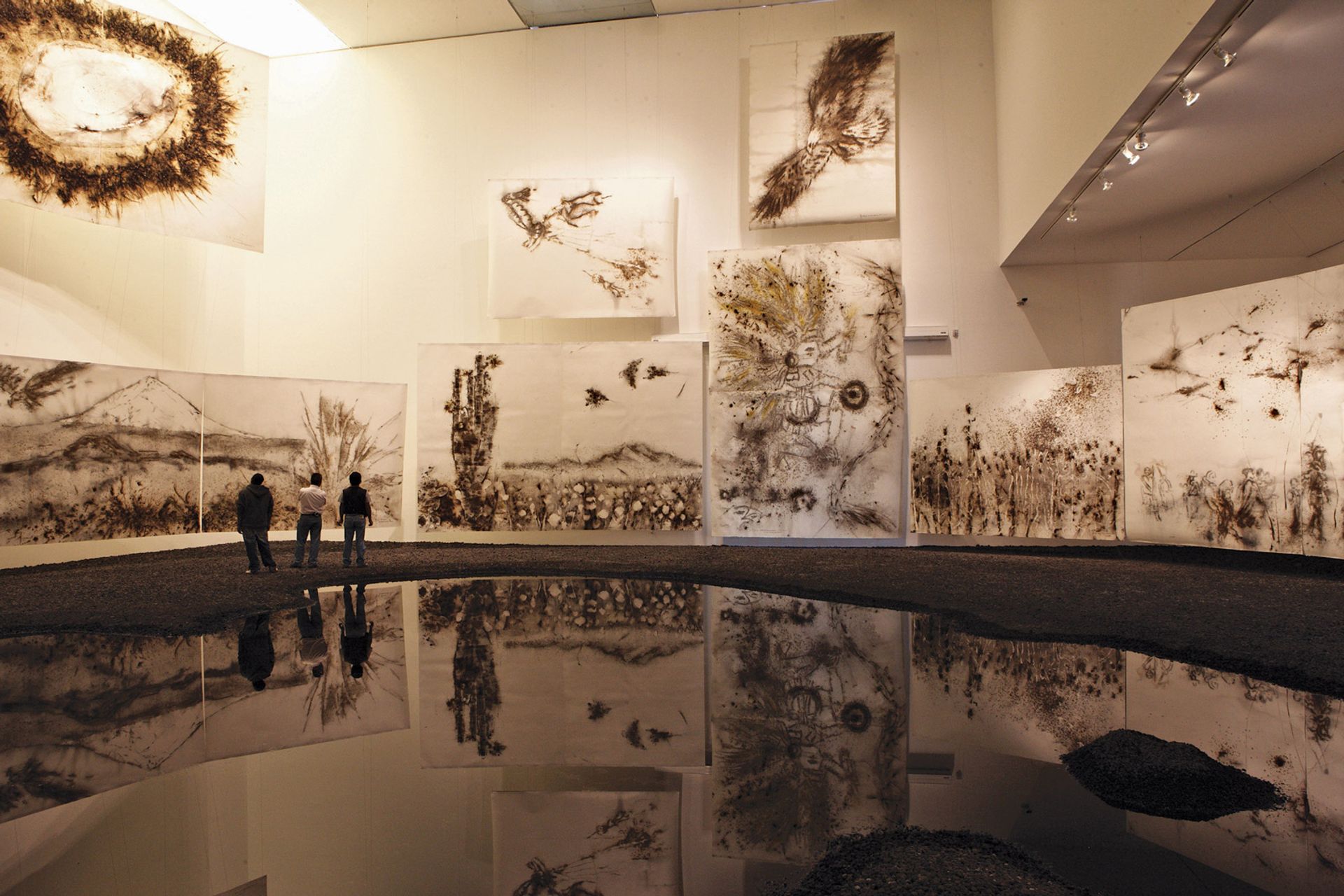
Cai Guo-Qiang's Sunshine and Solitude (2010), installed at the Museo Universitario Arte Contemporáneo in Mexico Urban center Photo: Diego Berruecos; courtesy of MUAC
Beyond delving into processes similar this one, the Getty was interested in exploring how Cai'south thinking, rooted in Taoism, abracadabra, feng shui, astrophysics and cultural history, relates to his materials, and how he envisions his works lasting in years to come up. To that end, researchers accept conducted probing interviews with the creative person and recorded oral histories, with Rivenc crisscrossing the globe–even travelling to Cai's birthplace of Quanzhou in Prc to proceeds insights from the artist's early mentors. For example, gunpowder, thought to take been invented in Red china in the ninth century, offered Cai a philosophical "opportunity for liberation" from "a timid and cautious personality", she says, as well equally a mode to invoke the material's clan with traditional Chinese medicine. "Sometimes these dialogues were quite personal," Cai says. "In plow, those interview questions helped me to reflect on myself."
The artist immune the Getty scientists to take microscopic samples from some of the early figurative oils and gouaches executed in People's republic of china in the early 1980s, often with paints he made on his own, and to chemically analyse the pigments. Limited mostly to whites and globe tones, they posed "no special conservation claiming", Rivenc reports.
The Getty besides took samples from transitional paintings in which Cai mixed gunpowder and realgar, an arsenic sulfide, into oil and acrylic paint, a procedure he started in China and connected when he moved to Nihon in 1986. (He remained in Japan until 1995, when he resettled in New York.) When lit, the cloth did not detonate but rather sizzled, leaving "an interesting surface typography", Rivenc says. Those works also proved "pretty stable" when tested, she adds.
One of the advantages of working with a living artist was his enthusiastic participation. For research into the gunpowder drawings, Cai created ten-inch by 10-inch test canvases for the Getty, sprinkling them with the range of gunpowders he uses and detonating them before shipping the works to Los Angeles. That enabled the scientists to bear a battery of tests. Using a microfadeometer, which includes an optical fibre that focuses an enormous amount of light onto the test surface, and a weatherometer, which subjects the work to cycles of light, humidity and temperature, they studied how the materials would age.
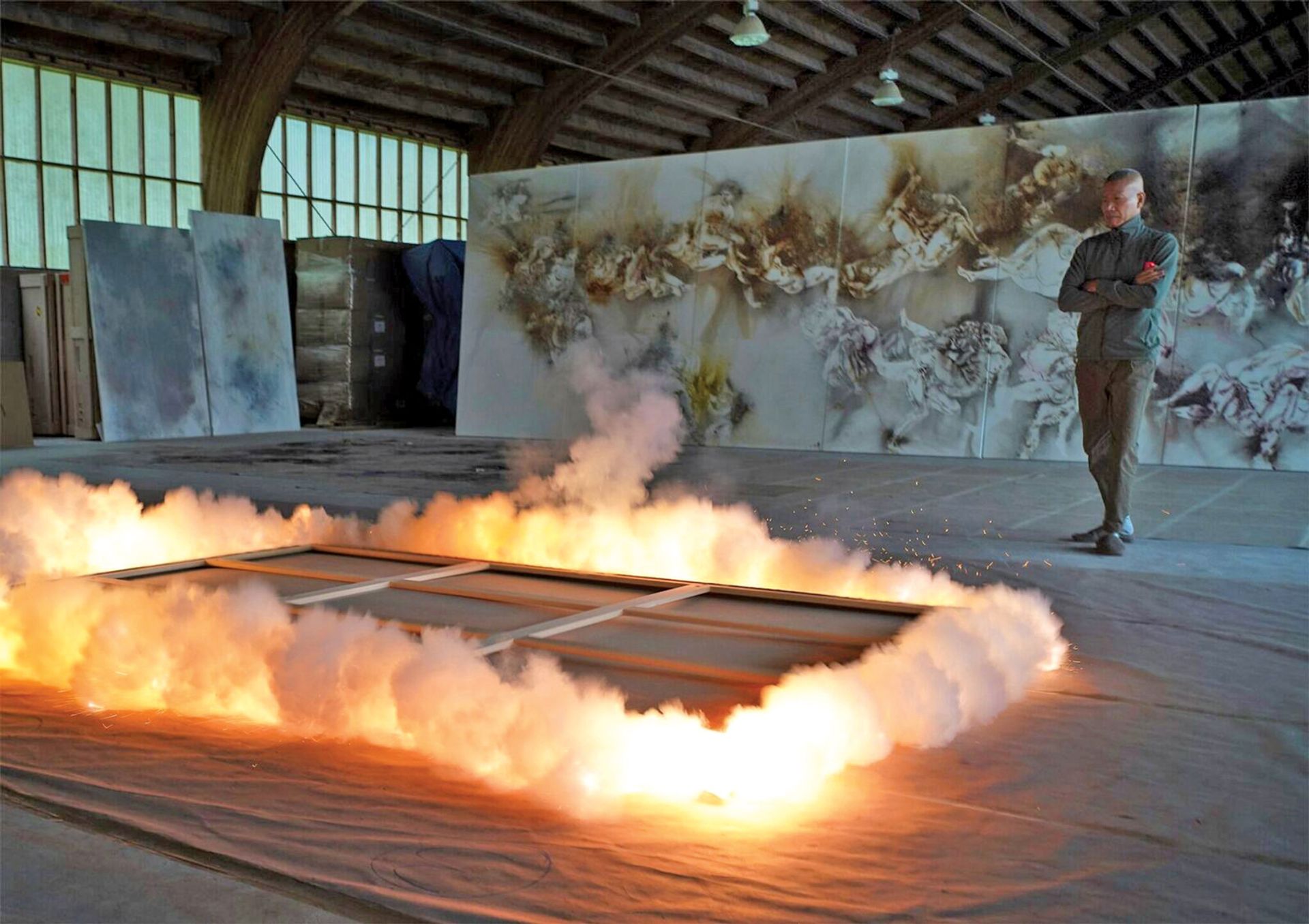
Cai Guo-Qiang overseeing the ignition of his gunpowder painting Study of Birds (2018) Photo: Tatsumi Masatoshi; courtesy of Cai Studio
Rivenc says the gunpowder held upward well. "Information technology seems fairly stable," she says. "Later on information technology'southward detonated, it might fade a chip over time but nothing dramatic." She recommends that owners and curators treat the gunpowder drawings as if they were executed in pastels or charcoal, handling them with intendance and guarding them from directly sunlight.
For the so-chosen coloured gunpowder paintings, Cai attaches canvas to a stretcher, sketches and applies stencils, and sprinkles coloured daytime fireworks ingredients over the surface earlier lighting a fuse. They do not detonate every bit strongly because up to xl% of the fireworks material consists of dye, reducing the explosive chemical element, Rivenc says. Tests with the microfadeometer and weatherometer showed that some of the dyes are particularly light-sensitive, including some scarlet tints, but will non be affected if proper precautions are taken, she adds. (A rich choice is currently on view in Flora Commedia, an exhibition of Cai's work running until 17 February at the Uffizi Gallery in Florence.)
Cai compares the Getty institute's solicitude over the works to treating an illness. "GCI dissects my works as if they are performing anatomical surgeries to examine the inner construction, bones, Dna and cells to obtain deep understanding of my torso and 'health'", he says. "For me, information technology's like you are in honey with someone: although she has some serious illness, y'all will all the same love her, and meanwhile think about how to better have care of her."
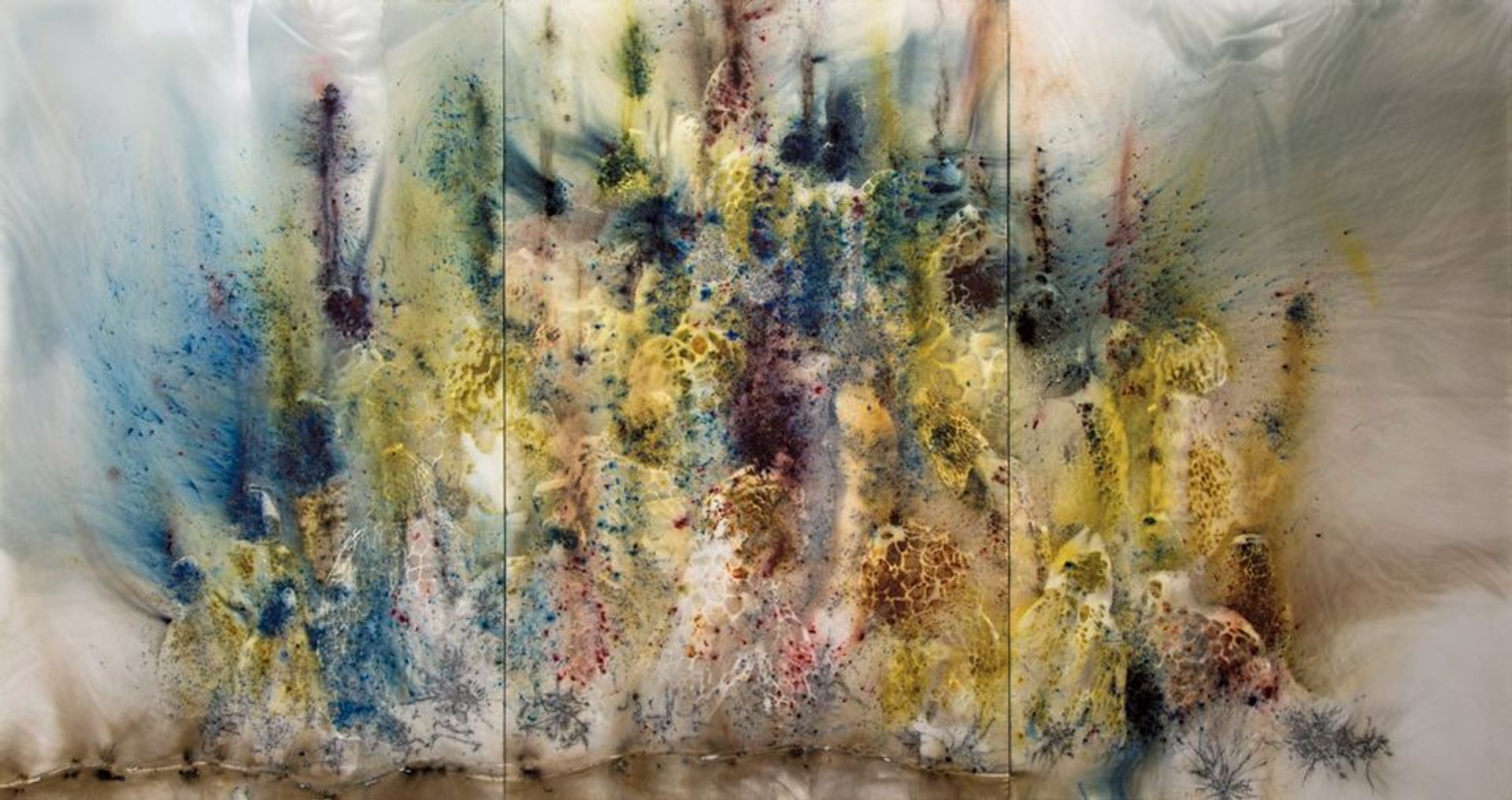
Cai Guo-Qiang's Mountain in Heat (2016), a work in gunpowder on sail Photo: Yvonne Zhao; courtesy of Cai Studio
At the same fourth dimension, he says he is "not too concerned" near the colourfastness of the works. "Ancient Roman sculptures and murals and cavern paintings in Dunhuang caves [in Mainland china] were painted in colours thousands of years ago," Cai says. "Some of them have undergone conservation treatments to restore original colours. Only after seeing those, I still feel as though the faded colours that carry the footprint of history look more enchanting."
Overall, Rivenc says, she was impressed past the stability of Cai'due south materials. "When you lot think that these materials were meant to be used for an event that simply lasts a few minutes and never to be laid on canvas, it is surprising how durable they are," she said.
"Information technology'due south incredible to be working with a living artist who's very interested in this," she adds. "With de Kooning and Fontana, there was no dorsum and forth: You come every bit close to truth, if there is a truth, with a net of clues. With Cai we can really accept a dialogue." In September the artist flew out to visit the Getty conservation labs, inspecting the equipment and chatting with the scientists.
Rivenc also has begun exploring Cai's daring installations, works as diverse as Caput On (2006), in which life-size replicas of wolves lunge at a glass wall, and Inopportune: Phase One (2004), in which nine Ford Taurus cars dangle from the ceiling. They present "a whole different set of problems", she said, like how to reinstall a slice that was originally site-specific and whether some elements should be replaced or repaired.
Meanwhile, the artist's experimentation with new materials continues. Recently he began detonating gunpowder on tempered glass, giving the Getty researchers yet another medium to test and ponder.
Rivenc emphasises that the Getty is not trying to influence Cai's choices. "In terms of conservation, it's more like giving Cai the basis for an informed decision," she says. "We don't want our findings to hinder his artistic freedom."
Source: https://www.theartnewspaper.com/2018/12/21/cai-guo-qiangs-explosive-art-preserved-for-the-ages
0 Response to "What Type of Canvas Is Used for Gunpowder Art?"
Post a Comment