Art Nouveau Stained Glass Pattern Peacock Feather Stained Glass Pattern
Subsequently writing about medieval church glass in a few posts this commodity is about the stained glass that decorated secular buildings in the late C19th/early on C20th century (plus a few latecomers).

Fanlight in office on All Saints' Green, Norwich
But start, why the three hundred year gap in drinking glass making until its revival in the mid-C19th? Norwich was once an important middle for medieval glass painting [1, 2]]. The kaleidoscopic appearance of this window, with a feathered angel playing a lute and a reflection of a disembodied hand doing the same to a higher place, suggests it was salvaged afterwards one of the waves of destruction that followed the Protestant Reformation (C16-C17).

C15th Norwich School painted drinking glass from All Saints Bale, Norfolk [3]
Medieval glass was virtually exclusively religious. These C16th Norwich School roundels are refreshing for depicting non-biblical characters at work (plus a king enjoying the fruits of their labours)[four].

Four (of eight) 'Labours of the Months' roundels ca 1500-1525, attributed to John Wattock [4]. Clockwise from top left: 'Pruning', 'A Rex Feasting', 'Harvesting Grapes', 'Sheltering from a Tempest'.(c) Norwich Castle Museum and Art Gallery.
Painted vs stained glass. 'Painted glass' refers to the process of painting the pattern with a solution of metallic salts (e.g. silver nitrate) before firing, every bit in the medieval drinking glass to a higher place. 'Stained glass' also includes pieces of coloured glass arranged in a pattern and held together by strips of atomic number 82.
After the puritanical rampage there was footling ecclesiastical drinking glass-making until the corking religious revival of the C19th. In 1861, William Morris founded Morris, Marshall, Faulkner & Co with his Pre-Raphaelite friends, including Rosetti, Ford Madox Dark-brown and Burne-Jones. The company initially focused on church glass merely some of their patterns were applicable to the home. Gustatory modality-makers were keen to bring something of the Gothic/Arts and Crafts Revivals into their houses and the fashion for domestic stained drinking glass can largely be traced to Morris & Co, for whom Edward Burne-Jones was a master designer [5].

'Penelope', stained and painted glass console, designed for Morris & Co past Edward Burne-Jones – a major designer for the firm ca 1864. (c) Victoria and Albert Museum, London
This large house in Eaton, Norwich was built in 1905 every bit a late example of the English Domestic Revival style. The large window on the half-landing contains a series of nine painted-glass roundels based on the 'Signs of the Zodiac'.

The remaining three signs of the zodiac are fitted into a round window to the side.
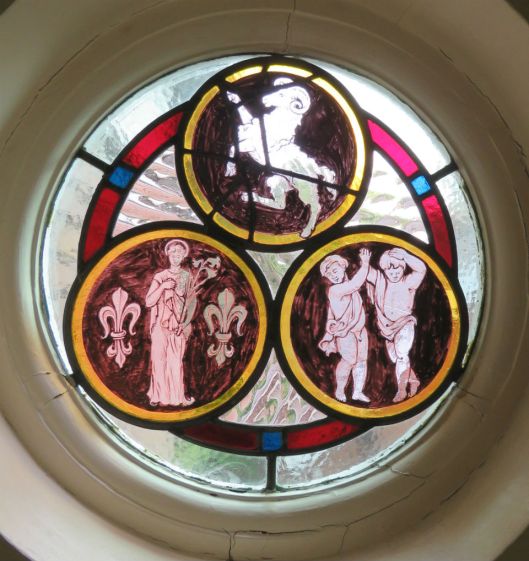
The hand-painted glass beneath is very much in the Arts and Crafts tradition. It is in the 1852 Heigham house built by Robert Tillyard, a leather merchant and one of the founders of the Norvic shoe manufactory [6, and previous postal service].

Stylistically, these paintings resemble Aesthetic Movement portraits of the 1870s-1880s. 'Juliet's' potent chin, below, is reminiscent of Morris' married woman, Jane.

The tiptop effigy is unlabelled; the lower pair carry the names Juliet and Elaine. Could these be a romanticised version of Tillyard's wife Julia and his girl Ellen?
In contrast to the unique paintings of Tillyard'due south family unit, the coloured glass panels that busy so many late Victorian doors were made in big quantities. Realistically-painted birds and flowers are typical of domestic glass of this flow.

Late Victorian stained glass door panels in the Gilded Triangle, Norwich. The inset shows the left-paw panel containing painted bird and flowers.

Front door console in a 1900 business firm Cecil Road, Norwich
Below, the flowers in the vase are not painted but assembled from individual pieces of coloured glass. The sinuous line of the leadwork and the move to abstraction anticipates the inflow of Art Nouveau.

Door panels in a firm on Unthank Route
The firm with the Arts and Crafts 'Signs of the Zodiac' glass (in a higher place) also has stained glass (below) containing the stylised Mackintosh rose of the Glasgow School (ca 1905). This nicely illustrates how drinking glass design adult: from its early Arts and Crafts origins through to the Art Nouveau that persisted in some class until the Showtime World War.

The highly stylised, and less sinuous, Mackintosh rose – the more muscular version of Scottish art nouveau.
Comparison between Victorian-looking stained glass and the new designs of the early C20th shows the simplification that occurred once Art Nouveau struck: patterns were less fussy and designs tended towards the abstruse.
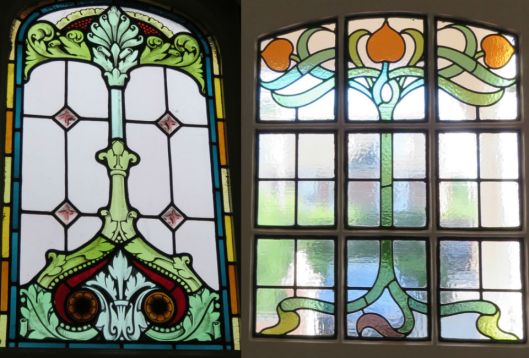
Left, a window from George Skipper's Hotel de Paris, Cromer (1895) and, right, an Fine art Nouveau door panel from Unthank Route (ca 1910) illustrate different means of handling a similar theme: the design on the left is mostly painted, the right is a mosaic of coloured drinking glass ready in lead.
The upper window lights around the dining room in the Hotel de Paris offer a scenic tour around Cromer. The glass paintings appear to have been skilfully copied from photographs.

Hotel de Paris Cromer dining room has painted roundels depicting sights around the expanse; here, the boondocks itself
Past dissimilarity, Art Nouveau-influenced glass is hardly representational; flowers, for instance, were not necessarily identifiable, simply generically floral.

Stained glass fanlight and door panel on Christchurch Route

2 panels, bearing stylised flowers, and a fanlight in stained glass, Park Lane, Norwich
As part of this simplification the lead itself became an intrinsic part of the overall design. Of practical importance, the relatively small-scale amount of stained drinking glass allowed more light into the hallway.

The colours here are subdued. Valentine Street, Norwich

Larger houses ca 1900 had room for six-panel windows on the half-landing. Mile Terminate Road, Norwich

Front door panel from an Arts and crafts house (congenital 1904) on Lindley Street, Norwich

Upper lights in a bay window of the aforementioned business firm on Lindley Street

Hall window of Lindley Street house showing opalescent glass panels
George Skipper'due south Royal Arcade (see previous postal service) is the city'southward well-nigh expressive Fine art Nouveau edifice. This semi-round stained drinking glass panel above the east archway contains birds flying amid trees begetting stylised daisy-like flowers.

East end of Royal Arcade 1899
The Purple Arcade, with Fine art Nouveau tiles designed past WJ Neatby of Doulton Lambeth, is decorated with peacocks. In this large stained drinking glass window the repeated motifs resemble the eyes of peacocks' feathers.

Back of The Regal Arcade, first flooring Jamie's Italian (not attainable to the public)
After the Beginning World war, and the demise of Art Nouveau, stained glass door panels oftentimes depicted cosy, reassuring images, as in these adjoining houses in Cecil Road.

Door panels from bordering houses ca 1920-xxx
Although the glaziers of the interwar years rejected a return to the pared downwards geometry of the Art Nouveau, they were content to utilise other, more representational images from around 1900, like the sailing transport (see post on The Sailing Ship equally an Arts and Crafts Motif).

Left: interwar house on Kett's Hill; St Stephen's Road ca 1905.
The Gatehouse PH (subject of previous postal service) was congenital in 1934. This turreted building as well looks dorsum to the Craft style, with cartoon-like medieval glass to match.
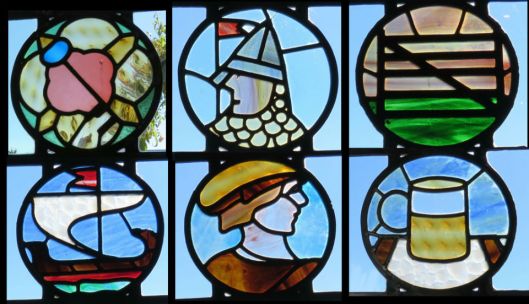
Montage of cameos from The Gatehouse PH, Dereham Road.

The benefits of reading. Above entrance of Mile Cross Branch Library, Aylsham Road, Norwich 1931

The benefits of drinking. Advertising glass at The Ribs of Beef PH at Fye Span,Norwich
The Norwich Society helps people relish and capeesh the history and graphic symbol of Norwich. More details on their website world wide web.thenorwichsociety.org.united kingdom

Thanks to Keith Roberts, Grant Young and Gareth Lewis and all who let me photograph their drinking glass.
South ources
- Woodforde, Christopher (1950). The Norwich School of Glass-Painting in the Fifteenth Century. Pub: Oxford Academy Press.
- See previous mail service on Norfolk's stained glass angels http://wp.me/p71GjT-t
- http://www.norfolkchurches.co.uk/bale/bale.htm
- Vance, Francesca (2013). Stained Glass Roundels: the Labours of the Months.
In, Masterpieces: Art and E Anglia, exhibition catalogue (ed Ian Collins) SCVA.
- http://collections.vam.ac.uk/item/O8452/panel-morris-marshall-faulkner/
- Holmes, Frances and Michael (2013). The Story of the Norwich Boot and Shoe Trade. Pub: http://world wide web.norwich-heritage.co.uk.
Source: https://colonelunthanksnorwich.com/2016/09/08/stained-glass-arts-crafts-to-art-nouveau/
0 Response to "Art Nouveau Stained Glass Pattern Peacock Feather Stained Glass Pattern"
Post a Comment