Script Authorization Failed. Please Check Your Pop-up Blocker Settings and Try Again.
Frequently Asked Questions
Hither are some mutual questions regarding site speed issues and GTmetrix usage.
General Site Speed FAQ
1. Why should I be concerned with my site's speed?
Your users' experience in terms of navigating your site should exist a neat reason. Users have many options when it comes to consuming content on the internet, and a deadening performing website will frustrate your users, sending them elsewhere. A faster and more responsive website will keep them more engaged and focused on your content, rather than waiting for scripts and images to load.
Another reason is SEO. Google already uses page speed in their ranking algorithm, and plan to incorporate Page Experience in their ranking algorithm as well, through the Spider web Vitals initiative.
This ways that faster loading sites with a good user experience may rank higher in search engine results. As developers and marketers look to optimize their sites, page speed and page experience should be amidst the top optimizations to consider.
2. My site loads pretty fast... why should I change it?
It'south all about efficiency and optimization. Your site may be loading fast, but information technology could be faster if you accept some of the best practices into consideration. You might even be able to reduce bandwidth and hosting costs by minimizing your footprint.
Also, your site may be loading fast but a visitor may not perceive that to be the case. You lot should understand how your site loads so that you lot can focus on providing a positive user experience.
3. Now that I take my scores; What practise I do at present?
Showtime optimizing your site! GTmetrix provides explanations for each audit and gives you actionable communication. The audits in the report are ordered in terms of which ones have the highest affect on your site. Fixing items at the top of the list tin can take a bigger impact on your overall score.
Make sure you fully understand the audits before y'all begin though. While many of them are applicable to your site, some are non. The audits are meant to be generic best practices- yous don't absolutely need to set everything. Start by focusing on the Web Vitals.
Experience free to contact u.s. if you have any questions.
4. My server code is optimized. Is this enough?
It's a start - but the code that really needs to exist optimized is the user facing code. Front end-finish optimization (of CSS, JavaScript, images, HTML, etc) is what's going to brand the most bear on on your users. Often nosotros but concentrate on server side optimizations, making the lawmaking as efficient equally possible in that location; but we forget that we tin get an even bigger increase in performance and improve the page experience if we optimize the front-end code as well.
5. I have a _______ type of site. Why is information technology asking me to do Ten?
The audits are not always relevant to your site (Eg. You do not need a CDN if you lot're running a small website or web log). This is why it'south important to truly understand the audits and how they tin can affect your site. Not everything will use to your site.
Visit our audits page to learn more nearly each inspect.
vi. I don't accept control over X, why is it asking me to set information technology?
Most sites include lawmaking for services like ads, analytics or other widgets. These $.25 of code may fetch JavaScript or CSS from other sources. Of course, since you have no control over these resource, there'south zero you can (or demand to) do.
seven. Do I have to set everything?
No, non at all! Start with the audits that appear in your Summary Tab. Then move onto your Structure Tab, where all the audits are ordered past what has the almost touch on on your score.
Realize that 100% is not realistic, and a green score by and large means your site functioning is optimized. Remember that these tools are meant to be used for a wide variety of site types, and so some audits may not apply to your site.
8. How much of an impact will doing this accept on my search engine ranking?
In general, there volition be an impact; however, there is no definitive answer on how much. Google had made page speed a ranking factor for websites in 2010, for mobile sites in 2018, and will mark pages as "Fast page", potentially ranking them higher in search results.
In general, Google is gearing toward a more than responsive web to make information technology "more delightful" for users across all spider web browsers and surfaces.
Despite this, Google has made it clear that even though site speed and page experience are important, they will continue to prioritize pages with the all-time information overall.
Therefore, don't practise it for SEO, do it for your users!
nine. Why did my scores/performance change when I inverse screen resolution?
You probable take a responsive website pattern. When the screen resolution changes to a larger or smaller size, the layout and styling of the page besides changes. Depending on your styling, your page could potentially be delivering larger/smaller images and hiding/revealing avails or resources. All of this impacts the load performance of your page.
In add-on, As of October 12, 2017, GTmetrix now defaults to a screen resolution of 1366x768 for tests. You tin can read more than well-nigh the alter here.
GTmetrix FAQ
1. Why won't GTmetrix analyze my URL?
Check to encounter if your URL is in the proper format (eg. http://www.case.com). Another reason may exist that the URL you lot entered requires yous to be logged in first, and/or information technology is being redirected to another URL.
Some URLs might not work for any number of reasons. Here are some errors that might prevent your URL from existence analyzed:
- Invalid URL
- Didn't render a 200/300 condition response
- Didn't render an html page
- Internal Server Error
- Unable to get screen capture
- Timed out
- Didn't complete due to pending request (image too big, unresponsive request, etc.)
If your URL won't clarify, read our General GTmetrix Errors weblog article to learn more on why this may be the instance.
ii. Why would I want to monitor my URL and how can I practice information technology?
Monitoring your URL allows you to go along track of performance over fourth dimension and see whatever changes when they occur. Combined with our monitored alerts, you can know when your website is performing poorly right away, and take steps to correct it.
One time y'all've analyzed a URL, y'all'll arrive at its report folio. Click on "Monitor" on the correct manus side to open the carte where there's a dropdown that allows for different monitoring schedules. Choose your desired schedule and salve your settings.
GTmetrix will now monitor the specified URL.
Read our How to gear up up Monitoring and Alerts web log commodity to larn more.
3. How many URLs can I monitor?
Basic/Complimentary users tin can but monitor one URL Daily, Weekly, or Monthly. Upgrading to GTmetrix PRO allows you lot to monitor more than URLs down to an Hourly frequency.
4. My PageSpeed Insights scores are dissimilar from my GTmetrix scores; Why is that?
To answer this question, nosotros need to clarify the groundwork of each tool in general.
PageSpeed Insights and web.dev are Google'southward own tools that use Lighthouse in their ain ways. The key divergence is that PageSpeed Insights provides Chrome User Experience (CrUX) data - actual user information collected from Chrome browsers around the world to provide data on real user performance. Spider web.dev (and GTmetrix) are considered more lab/synthetic tests, where assay is performed in controlled environments and scenarios.
With regards to results, in that location are various reasons why your Performance Score on either platform differs from GTmetrix. Read more about this here.
5. How long does GTmetrix go on my reports for?
All written report history and data volition exist retained for a specified number of months depending on the program you're on:
- Guest (non-logged in) users: 1 calendar week
- Bones: 3 months
- Solo, Starter, Growth: vi months
- Champion, Team: 12 months
- Enterprise: 24 months
The retention fourth dimension starts from the written report generation date. Afterward the time has elapsed, reports will be purged from our database and are non recoverable.
half dozen. Are there any privacy settings?
Yes - If you don't desire anybody to see a item written report for your URL, click on "Page Settings" on the right hand side. Under the "Privacy" heading y'all tin can choose whether or not to make the report private, or allow anybody to run into it.
Keep in mind that though a individual study is protected from public view, anybody can create a report for any URL. If you tin load the URL in your browser, you can analyze it in GTmetrix.
vii. My graphs don't seem to be changing. Why?
A skillful reason could be that there haven't been major changes or optimizations washed to that URL. GTmetrix tracks the performance of URLs, but unless any development or improvements accept been done, the graphs will keep a straight line.
Monitoring is good for developers who are doing ongoing testing or optimizations for their site and desire to track it over time.
8. What is the GTmetrix Bookmarklet and how do I use it?
Exam with GTmetrix
The GTmetrix bookmarklet is a snippet of JavaScript tool that allows yous to clarify the functioning of the current page with a single click.
Read more on our blog entry.
Note that regardless of the browser y'all visit GTmetrix with, GTmetrix always runs the tests with the Chrome browser.
nine. How practice I compare URLs?
Subsequently having generated a report for a URL, click "Compare" in the height right. A carte will appear where you tin can enter the URL yous wish to compare with the written report. You will then be taken to the Compare screen with the comparison results.
If you would similar to compare more URLs, click the "Add another URL" button - you lot are able to add up to iv dissimilar URLs.
Note: The report from which you clicked "Compare" will be the base report. All additional reports volition be compared confronting this study.
10. Can I compare an existing report with another report?
Yes! See instructions on how to compare GTmetrix Reports here.
12. I have a page that requires HTTP Authentication. Tin GTmetrix analyze it?
Aye! Log into your GTmetrix account and expand the "Analysis Options" drawer.
Click "Advanced Options" to reveal the HTTP Hallmark fields.
Enter in your .htpasswd Username and Password and click "Analyze". GTmetrix will laissez passer in the credentials and clarify the page.
Y'all can too enter the username and password using the http://username:password@example.com/ syntax, only usernames or passwords containing @, :, or / must be URI encoded.
The login details will not be displayed in the report (and will likewise be stripped from the HAR file), merely will be saved for hereafter use - you will be able to re-analyze the folio without entering the login details.
Notation: this characteristic but works for HTTP Authenticated webpages (eg, pages protected using an .htpasswd file) - this is different from a cookie based session (see the adjacent FAQ detail for more details).
fifteen. How can I see the touch on ads have on my site?
Log into your GTmetrix account and nether the URL field there will exist an "Analysis Options" push.
Tick the "Adblock Plus" option. Your URL will be scanned with the ads blocked. You can as well enable this pick in the "Folio Settings" button on the Report page sidebar.
Blocking ads is helpful if you want to see the impact the ads are having on your page load times.
Currently, GTmetrix just offers the ability to enable and disable the usage of Adblock Plus. The Easylist English filter subscription is used as the default filter set.
For more information on testing with Adblock Plus, read our How to block ads in GTmetrix tests weblog article.
16. How can I test a site from a different location?
GTmetrix has numerous test servers located worldwide, which you are able to apply for testing your site's performance. Y'all tin can specify which examination server to apply by selecting a test server in the "Assay Options" button, on the dashboard page.
Read our Which location should I examination from? blog article to learn more than.
17. How can I test my mobile performance?
For PRO users, GTmetrix offers page analysis through an actual Android device (Galaxy Nexus) and a multitude of simulated devices. On your Dashboard, click "Analysis Options" and select one of the various mobile devices and tablets in the in the Exam Format dropdown. If yous wish to re-examination from a Report folio, click on "Page Settings" and change your Test Format settings there. Re-test!
Read our How to test with mobile devices using GTmetrix blog article to learn more.
eighteen. What tin connection throttling tell me?
By simulating a detail connexion speed, you tin place whatsoever potential loading issues for your target audiences. For case, if a big percentage of your users are coming through mobile devices, it would exist skilful to see how your site performs under a 3G/2G connection to ensure a speedy load time for that user base of operations.
xix. How does GTmetrix throttle connections?
GTmetrix utilizes specially customized software to simulate whatever kind of connection. Nosotros do this past putting limits on our fibre connection's download speed, upload speed and latency. We throttle both IPv4 and IPv6 traffic when analyzing your folio to ensure that report data is accurate.
twenty. Why isn't my CDN being recognized?
GTmetrix auto-detects well-known and popular CDNs. Since there are hundreds (if not thousands) of CDN services bachelor, there are times when a CDN is non recognized past GTmetrix. In this example, we commonly require the CDN provider to accomplish out to us for a CDN review and then that we can add it to our auto-detection.
If GTmetrix isn't detecting your CDN, and then you tin add your own CDN hostnames and so that they aren't penalized by the CDN audit. Visit your Account folio and then nether the User Settings, input your CDN hostnames in the "CDN Hostnames" field. GTmetrix should then recognize these domains as CDNs in all your future tests.
Annotation that if you're using Cloudflare, GTmetrix should automatically detect the CDN usage if information technology'south fix correctly and y'all've given information technology plenty time for the DNS to propagate (typically takes up to two days).
21. How exercise I use the Resource Usage Graph?
The Resource Usage Graph is meant to be a companion to the Waterfall Chart. When used together, information technology can provide more than insight on breaks in the Waterfall Chart, long download times of elements and other potential issues.
Information technology is not meant to be a stand-alone metric, and at that place is no "score" related to it; rather information technology gives a view of what the browser is going through while loading your website.
22. What does the CPU Usage Graph hateful?
This graph indicates the level of processing resources needed past the browser to render your page at whatsoever given indicate. Websites with circuitous layouts, high interactivity, and demanding extensions (east.g. Flash) are more demanding on a computer, resulting in a higher CPU utilization. In addition, inefficiently written scripts (e.g. JavaScript) might cause stalls in page loads. There might be cases where the CPU utilization is pegged at 100%, meaning the browser is trying its best to process a script - and in doing so, blocks other page elements from being loaded or rendered (look for gaps in the Waterfall Nautical chart).
23. What does the Memory Usage Graph hateful?
Similar to the CPU usage graph, the memory usage graph shows the amount of memory required past your browser to return the page. It also tin exist used to get a heads upward on inefficient or buggy code (e.m. memory leaks) and can give you a starting point on where to look if your website is performing slowly.
24. What does the Bandwidth Usage Graph mean?
This graph shows you how much data your site transfers when it is requested. Use it together with our throttling feature in order to better understand how your page loads on slower connection speeds, like 3G connection or DSL connection. If your site maxes out bandwidth on desired connections types, you lot may run across long bars in your Waterfall Nautical chart.
25. Why tin't I see my Resource Usage Graphs?
There are a number of reasons why the Resources Usage Graph may be unavailable to you:
- It is an sometime GTmetrix report (generated before the release of Resource Usage Graphs).
- The browser choice selected to test the URL doesn't generate Resource Usage information (e.g. Chrome - Android/mobile).
- The folio loaded too rapidly for whatever data to be nerveless (<100ms).
26. What is the difference between "elapsing" and "fourth dimension"?
A "duration" is a menstruation or how long something took (east.g. Ten processed for 3 seconds).
Durations: Redirect, Connect (including SSL Connection Time), Backend, DOM Content Loaded, Page Loaded
A "time" is the point an event occurred in relation to the start of the test (e.g. X occurred at 2.one seconds).
Times: Fourth dimension to first byte (TTFB), Kickoff Paint, DOM Interactive, DOM Content Loaded, Folio Loaded, Fully Loaded
Notation that Page Loaded and DOM Content Loaded have both a time and duration. The duration is how long the JavaScript for that event ran for, while the fourth dimension is when those events fired.
27. What is the difference between Onload Time and Fully Loaded Time?
-
Onload Fourth dimension - is when the processing of the page is consummate and all the resources on the folio (images, CSS, etc.) have finished downloading.
- This used to exist the indicate where GTmetrix would finish the test and marking as the Folio Load Time in the GTmetrix written report.
- Bug with using this issue: Some elements of the page load may not make it in before this event fires - like JavaScript based image carousels - causing inconsistent page load times and inaccurate screenshots.
- When should I use Onload Time? In general, in that location's no real definitive instance to prefer Onload Time (which is why we defaulted to Fully Loaded Time), though certain specialized cases might telephone call for it.
-
Fully Loaded Time is the betoken after all of the following accept occurred:
-
First wait for these conditions to be met:
- Beginning Contentful Paint has fired
- Onload has fired
- Network is idle (v.25s of ii or fewer in-flight requests subsequently DOM Content Loaded has fired
-
Then wait for:
- CPU is idle (5.25s of no long tasks)
- Hard fourth dimension out of 30s subsequently Onload has fired
-
Finally, when the above conditions are met, we then have the maximum timing of:
- Outset Paint
- Commencement Contentful Paint
- Onload Fourth dimension
- Largest Contentful Pigment
- Time to Interactive
- Concluding request captured
-
Essentially, GTmetrix is now waiting until your page stops transferring data earlier completing a test, resulting in more than consistent Page Load Times.
-
Possible issues with using this event:
- This issue fires only when a page completely stops loading content, including ads and below-the-fold elements.
- Fully Loaded Time waits for a folio to terminate executing JavaScript (measured from First Contentful Pigment (FCP) to the last long task; also known as Time to Interactive).
Your site might have loaded fast above-the-fold and be usable, notwithstanding since the analysis is at present waiting for the entire site to stop loading data, your reported Page Load Time might be longer.
-
28. How do I change the time to cease test?
Yous tin modify your time to end examination to Onload Time past enabling the "End exam onload" option in the Assay Options (log in required) or changing the setting on an existing study in the Page Settings. Yous tin can too change your default in User Settings from the Business relationship page.
However, we practise recommend sticking with using Fully Loaded Time unless you have a specific use case for it.
"Cease examination onload" option is simply available for Firefox and Chrome (Android) tests, which generate Legacy Reports (i.east., PageSpeed/YSlow).
29. When I compare my Simulate Device folio performance to the bodily device, why are they unlike?
Our Simulate Device feature works by telling our browser to identify itself as the selected device through the User Agent string. We and then modify the Screen Resolution and set the appropriate Device Pixel Ratio for the device to lucifer also. Nosotros have combinations of these options for many of the pop devices used today.
Hardware performance is not simulated still. The functioning differences probable stem from the fact that GTmetrix uses server-form hardware to launch a browser and load pages, which differs significantly from the actual device'due south hardware performance (mobile CPUs, GPUs, memory, etc).
30. How authentic is the Simulate Device feature?
Simulate Device tin give you a dandy idea of whether or not your site adheres to mobile recommendations and may aid optimization with layouts dependent on User Agent specific styling. Combined with Screen Resolution changes, you can really go a general sense of your folio display and operation in terms of total folio size.
However, actual load fourth dimension is less representative, due to the hardware caveat mentioned to a higher place, which is why you should still test your page on the actual device in order to go real globe performance benchmarks. In addition, rendering engines on various devices may differ (e.thousand. if the user is using Firefox mobile as their primary browser), resulting in different real world operation.
Our Simulated Device characteristic gives you a proficient starting benchmark to gauge your functioning with on these devices, but they should not exist regarded as 1:i comparisons.
31. What happens to my report data later on I downgrade?
Here's what will happen to monitored pages and their corresponding data:
- If you currently have more monitored pages than alloted for in your new plan, GTmetrix will disable monitoring on a number of them to align with your new Monitored Slot limit.
-
All report history and data will be retained for a specified number of months depending on the programme you downgraded to:
- Basic: 3 months
- Solo, Starter, Growth: vi months
- Champion, Team: 12 months
The retention time starts from the report generation date. Later on the time has elapsed, reports volition exist purged from our database and are non recoverable.
Every bit a courtesy, we delay the purging of your study data for 2 weeks subsequently you've downgraded and then you can go things sorted.
GTmetrix Analysis Errors
one. Network connectivity errors
There may be a connectivity event between your server and the GTmetrix test server if you go errors like "Read timeout", "Write failed", "Broken pipe" or "Connectedness reset by peer".
Yous tin can endeavour again later, or effort testing from some other 1 of our examination locations (requires log in). If it fails from multiple locations, it usually means that it'due south a problem on your end and your users are experiencing similar issues. Contact your hosting provider to go the issue resolved.
2. Server status errors
GTmetrix only analyzes pages that return a successful HTTP status code. If you become this mistake, your page has returned an error HTTP status code.
The nearly common reasons for this include:
- Your web application generating the folio is incorrectly returning an fault HTTP condition code, simply is returning page content that does not indicate an error.
- Your web application is blocking GTmetrix from accessing the page. With WordPress, it could be due to plugins like Bad Behaviour or Wordfence. With due east-commerce software, it's common that the access is blocked based on the IP.
- You are using a reverse proxy (eg. CloudFlare) and it'due south blocking GTmetrix from accessing the folio.
In all these cases, y'all'll need to fix or configure your spider web application to render a successful HTTP status code or allow GTmetrix access to your page. Your spider web server'south error log may provide insight into why it's returning an error.
3. SSL certificate errors
GTmetrix only analyzes HTTPS sites that have a valid, trusted SSL certificate (ie. not cocky-signed, non-expired, matching common proper noun).
A common problem with HTTPS sites is that the intermediate/chain certificates aren't installed correctly. If you don't have the intermediate certificates installed properly, some users (including GTmetrix) will get an SSL certificate fault while viewing your page. For instructions on how to properly install your SSL certificate and to test your SSL certificate visit SSLShopper.
4. DNS errors
If GTmetrix has problems resolving your site's domain, so you may have DNS configuration issues. You can get a report on your DNS configuration at intoDNS - be sure to look into the items that are marked as cherry-red.
However, if your site has recently changed proper noun servers or changed its DNS configuration (eg. moved servers), then the event might exist that your DNS records have been cached. Depending on your configuration, this may take up to 24 hours (at near 48 hours) to propagate. Endeavour re-testing your page at a later time.
5. Your page took too long to load
The maximum time GTmetrix will await for a folio to load (time it takes for the window.onload event to fire) is 2 minutes.
The most common reasons for this error are:
- An extremely slow loading folio or resource or lots of wearisome loading resources.
- JavaScript that'southward preventing the window.onload event from firing.
For slow loading pages or resources, testing from a closer test location (requires log in) may help speed things up.
6. The URL did non announced to be an HTML page
GTmetrix only analyzes HTML pages. To ensure that your page is an HTML page, GTmetrix checks the Content-Type header for text/html.
You lot also may get this error if the Content-Type header is missing or the value is empty. The problem is likely an event with the web application and not the web server.
7. JavaScript redirect or meta refresh
Unfortunately, GTmetrix currently does not handle pages that perform meta refreshes or utilise JavaScript to redirect the page. However, yous tin work around this outcome by visiting the page in your own browser to find the final redirected URL - this is the URL to use with GTmetrix.
You as well may erroneously get this message if your page opens a popup that evades the browser'due south popup blocker. Unfortunately, there is currently no fix for this other than to ensure that your folio does not open the popup (the Block URL option may also help work effectually this issue).
GTmetrix Payment & Billing
i. My credit card keeps getting declined, but it's worked for other purchases - Why?
There are many reasons why a transaction tin be declined (even with a valid credit card). Some common reasons include:
- Your credit card is declining online or international transactions (GTmetrix is located in Canada).
- Your credit bill of fare has reached its credit limit.
- The transaction triggered your credit carte'southward anti-fraud system.
Nosotros realize information technology'due south a frustrating situation and apologize for any inconvenience. Read on for more details on declined transactions.
2. What can I do if my payment keeps getting declined?
Hither are a few things you can exercise:
- Re-enter your credit carte number and security code.
- Contact your credit card company to add GTmetrix as an canonical and legitimate charge.
- Try a different credit carte du jour.
If your payment still keeps getting declined, contact usa and we'll work with you towards another solution.
3. I've been successfully subscribed with my card for a while, only now information technology's getting declined of a sudden. Why?
This is hard to answer equally the fault code response we get is quite vague. Sometimes credit card companies have a change in security / fraud procedures or algorithms. Other times it'southward our payment gateway deciding to trigger an anti-fraud flag of a sudden.
It's unfortunate in any instance, merely we're set up and willing to explore solutions with you lot to get things working once again.
4. What payment options does GTmetrix have?
We take Visa, Mastercard, American Express, Discover, Diners Guild and JCB.
We tin can also accept Purchase Orders (PO), PayPal, Cheques and Banking concern Transfers, but these methods need to exist processed manually and require a Champion program or higher on a yearly term. Contact us to go this prepare upward.
5. I require a PO / manual invoicing for my GTmetrix PRO subscription
We tin assist you out! Let our team know using our contact class and we can ready things up for you lot. Annotation that nosotros only provide this service to users on Champion or college plans on a yearly term.
half dozen. I'g having trouble signing up for a PRO subscription!
Nosotros'll help you lot resolve your issue. Attain out to our team using our contact form and we'll work towards a solution.
seven. How do I update my Payment Details?
You lot can update your billing information by logging into your GTmetrix business relationship and visiting your Business relationship page.
On this folio, you lot'll come across a box with the link "Update Billing Info":
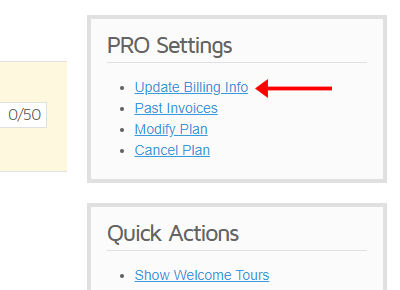
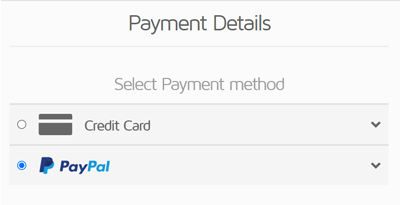
Click that and you'll exist taken to a course to update all of your billing data.
To update Credit Card details, click on "Update" next to the Credit Card input fields.
8. How do I view my past invoices?
You can find all of your GTmetrix invoices by going to your Account page - and then on the right menu block, click on "Past Invoices"
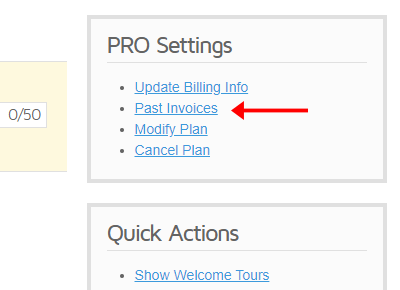
A sidebar will slide out and reveal a dropdown choice of all available invoices:
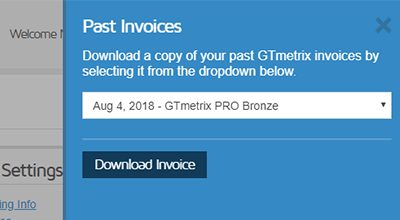
Just select your desired invoice and click "Download Invoice" to get a PDF version.
nine. How do I cancel my PRO subscription?
Sorry to hear you didn't notice GTmetrix PRO a expert fit =(
You can cancel your subscription from the Account page by clicking on "Cancel Plan"
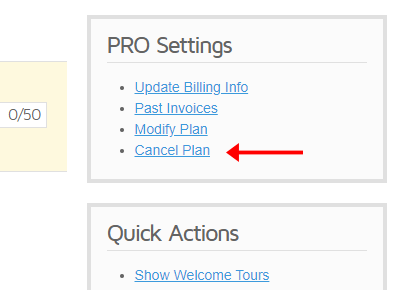
Follow the instructions and upon cancellation, you should receive an east-mail confirming your counterfoil.
Source: https://gtmetrix.com/faq.html
0 Response to "Script Authorization Failed. Please Check Your Pop-up Blocker Settings and Try Again."
Post a Comment