What Conflicts Continues as Russia to Dominate Again
Climbing the ladder: How the West can manage escalation in Ukraine and across
Table of contents
Introduction
Moscow'due south invasion of Ukraine is transforming Europe'due south security architecture, every bit well as NATO's strategic priorities and its defence and deterrence posture. Russia's ruthless assailment and NATO's response increase the possibility of purposeful or inadvertent escalation in Europe. Whether this takes the grade of heightened disharmonize in Ukraine, increased tension across the whole or parts of NATO'southward eastern flank—from Ukraine and the Black Sea to the Baltic Region and the Loftier North—or in non-kinetic, subthreshold domains, understanding how these dynamics might degrade transatlantic stability is critical. This study volition seek to identify key rungs on the escalation ladder effectually the state of war in Ukraine; assess how the current crisis might escalate inside Ukraine and across NATO's eastern flank; explore how the U.s.a. and NATO posture tin can preclude or limit escalation; and offering recommendations for how the United States and NATO tin can adapt their strategy, posture, and activities to manage escalatory dynamics.
In response to the invasion of Ukraine, the West has imposed stinging sanctions, disrupting the Russian economy and forcing the Kremlin to burn through its financial reserves. Major Russian banks have been disconnected from SWIFT, the international system that facilitates fiscal transactions, while some oligarchs have been sanctioned. Many allies and partners take provided massive fiscal and material assist—in the course of funding, as well as anti-tank and air-defense systems and other military equipment—to eternalize Ukrainian resistance. This assist has helped to stiffen an already stout Ukrainian defense, which has inflicted heavy losses on the Russian military. Vladimir Putin now faces the real possibility of a stalled offensive, or even outright defeat.
In this circumstance, Russian federation all the same has cards to play. Failure in Ukraine places Putin's political survival at run a risk and he is, therefore, unlikely to withdraw. His present difficulties are more than likely to provoke escalation within or effectually Ukraine, both in the military realm and in other domains. Equally he climbs the escalation ladder, Putin's risk tolerance volition increase, equally his fundamental subordinates will surely realize. The ultimate risks, however, are removal from office, imprisonment, or even execution. Accordingly, Putin is far more likely to press harder in Ukraine than to acquiesce to a negotiated settlement that leaves him without tangible gains.
The following give-and-take of Russian escalatory options is linked to the progress of the campaign in Ukraine and presents alternating scenarios based on Russian progress or failure and the degree to which the West provides critical support and/or direct intervention. Escalatory steps are described in ascending guild of severity and take chances. Response options to command or mitigate Russian escalation follow. Information technology is important to note that Russian, Ukrainian, and Western perspectives or "lenses" on what is escalatory may differ significantly in both time and infinite. This factor must be borne in heed when assessing antagonist actions.
Escalation triggers
Equally Putin and his senior advisers consider options, conditions on the ground will drive their calculus. Should the Russian military machine manage to recover its footing and resume progress, however halting, more extreme options may be held in reserve. If the campaign evolves into a "frozen" conflict, like the Donbas but on a larger scale, Putin's focus will shift to destabilizing the Volodymyr Zelenskyy regime in Kyiv and sanctions relief. Should Ukraine achieve decisive success in recovering its national territory, Putin'southward survival may be at risk, and incentives to employ harsher and more high-run a risk measures will grow. Escalation to each of the below "rungs" will depend on Putin'southward perception and assessment of how the campaign is progressing and the prospects for ultimate success or failure. Though speculative, likely triggers for escalation into each subsequent phase of the conflict might include
- an assessment that the campaign has stalled temporarily and different approaches are needed to regain momentum;
- an assessment that the campaign has stalled outright and recovery is unlikely without more extreme measures; and
- an cess that defeat is imminent, and that Putin may autumn from power, placing all his options on the table.
Every bit the conflict drags on, NATO and European Union (European union) actions can be decisive one way or the other, as described further beneath.
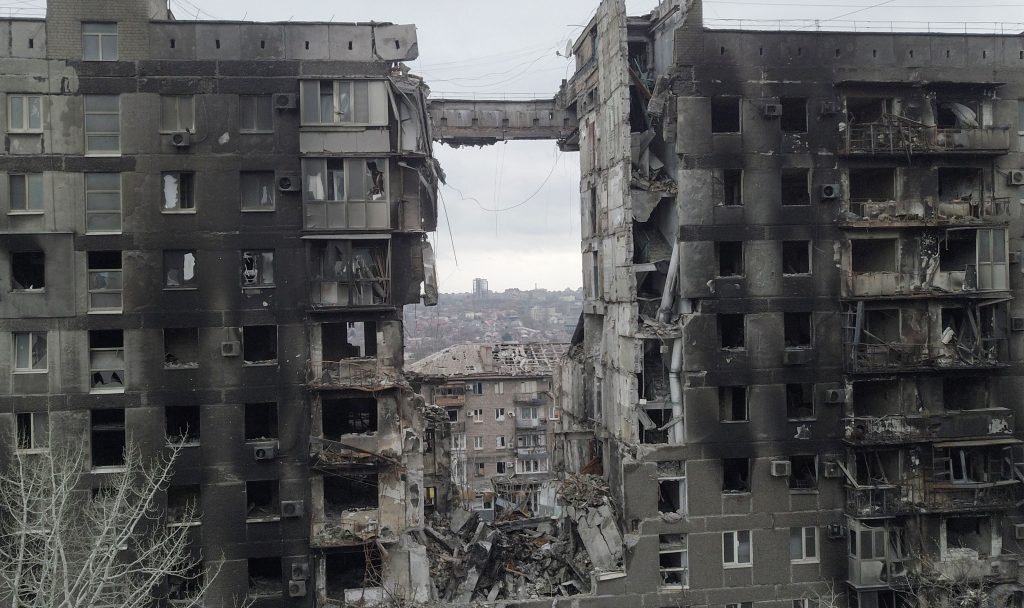
"We are already seeing the kickoff circular of escalation as Putin comprehends the failure of his initial invasion."
A view shows a residential building destroyed in the course of Ukraine-Russia conflict in the southern port city of Mariupol, Ukraine April 14, 2022. Picture taken with a drone. REUTERS/Pavel Klimov
The start rung
We are already seeing the first round of escalation equally Putin comprehends the failure of his initial invasion. Russian forces have partially or completely encircled key Ukrainian cities like Kharkiv, Mariupol, and others. In the absence of decisive military success on the ground, they have resorted to indiscriminate attacks and atrocities in civilian areas to cause terror and break Ukraine's volition to resist. These measures advise an indifference to international public opinion that may become even more than pronounced in the weeks and months to come. In the near term, further loss of power, food, medicine, and fuel volition impose cruel hardships on the civilian population. Attacks on the Zaporizhzhia nuclear plant, the siege of Mariupol (which has killed thousands of civilians), and attacks on cultural sites like the Babi Yar Holocaust Memorial in Kyiv make articulate that the gloves accept come off.
Every bit evacuation of civilians becomes more than difficult or ceases, the pressure on President Zelenskyy to capitulate or agree to harsh terms (such as the give up of Ukrainian territory, a pledge not to join NATO or the EU, and the presence of Russian troops in Ukraine (as in Armenia, Azerbaijan, Georgia, and Moldova)) will intensify. Russian federation has also begun to launch attacks in western Ukraine near the Polish border, signaling that further attempts to supply Ukraine with lethal aid will be opposed. Threats to raise nuclear alert levels; the movement of mobile intercontinental ballistic missiles (ICBMs) through the streets of Moscow; the recruitment of Syrian soldiers and foreign mercenaries; and the credible "stop loss" of conscripted soldiers approaching the terminate of their contract periods as well stand for expansion or escalation of the conflict.
Major powers similar Red china, Bharat, and Brazil have so far failed to condemn Russia, but are not likely to provide military support. The Russian Federation has not employed major cyberattacks, halted free energy deliveries or agricultural exports, jailed strange nationals in large numbers, or defaulted on loans owed to foreign banks. These and many other escalatory options may exist encountered as events unfold and Putin becomes more drastic.
The second rung
The latest phase of the conflict will be decided in the coming weeks. Should Kharkiv and Mariupol ultimately fall in Russia'southward new offensive in the Donbas and surrounding areas, other Russian advances in eastern and southern Ukraine could curlicue up the Ukrainian defense—potentially all the way to the Dnepr in the most devastating scenarios—effectively ceding the eastern half of the country to Russian control. A major part of Ukraine'southward regular forces will exist lost, and the narrative will shift as Russian offensive gains replace the dominant storyline of an obstinate Ukrainian defence force. Given heavy losses, international condemnation, and crushing sanctions, this may exist plenty to drive a negotiated settlement: a abeyance of Russian attacks in exchange for promises of neutrality and Russian de facto, if not de jure, control of eastern Ukraine. Putin might well claim victory, reconsolidate, work to undermine Zelenskyy'southward regime, and promise to install a pro-Moscow government as earlier.
Surging forces and increasing destructive activeness. At present, all the same, Ukrainian collapse does not look probable. Should Ukrainian defenses hold in the due east, or if Zelenskyy continues to defy Moscow and continue the fight without concessions, Putin will face more difficult choices. Internal dissent will continue to rise as casualties mountain and economic hardships and diplomatic isolation intensify. Putin has already committed nearly of his bachelor conventional forces to the conflict, and Russian stocks of precision-guided munitions, including ballistic missiles, take been drawn down. His side by side steps will be to expand conscription, mobilize reserves, strip outlying areas of their garrisons, and increase pressure on commanders to achieve results by threatening relief, imprisonment, or even execution. Any remaining restraints on attacks on civilians will exist relaxed, as seen in Grozny and Aleppo. Artillery, air, and missile strikes against cities will intensify, and targeted arrests and assassinations of Ukrainian officials will become more frequent. Nuclear plants in occupied areas may also be close downwardly to kill power in urban areas.
Equally it did in the Chechen wars, the Russian war machine will learn from its failures and adapt its tactics. To appointment, the integration of airpower, arms fires, and electronic warfare with maneuver forces has been unimpressive. This will likely improve, though perhaps non dramatically. Damaged forces volition be pulled back to be reconstituted and reequipped, though replacements are probable to be poorly trained. A chaotic command and control construction, with a theater commander to coordinate the twelve army and two corps headquarters in Ukraine, is under revision. Although a theater commander has been appointed, we do non know if he commands all ground forces formations, or if his authorisation extends to special-operations forces, airborne forces, naval infantry, the national guard, and other diverse formations of the Russian Military and security services. The utilise of "battalion tactical groups" with their ain arms has clearly failed. Reversion to the more traditional regiments, brigades, and divisions may follow, forth with a recentralization of field artillery to generate more than powerful furnishings.
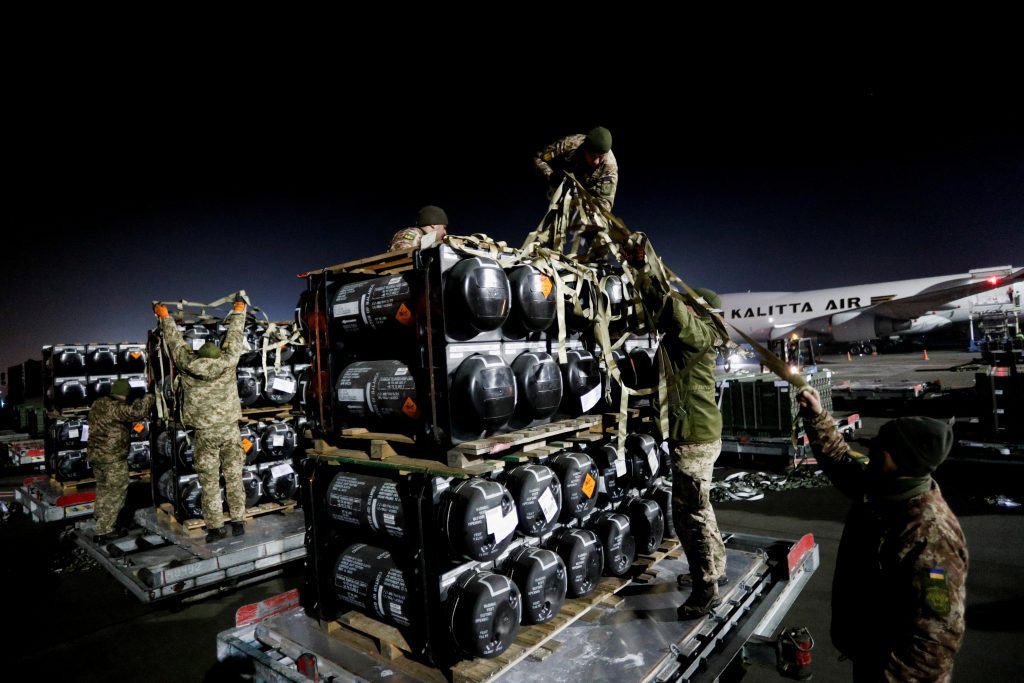
"Every bit Western-provided lethal aid becomes more and more decisive, Putin will step up his efforts to interdict footing lines of communication, raising the chances of fires that stray beyond national boundaries into NATO territory."
Ukrainian service members unpack Javelin anti-tank missiles, delivered by plane equally part of the U.S. military support package for Ukraine, at the Boryspil International Airport exterior Kyiv, Ukraine February ten, 2022. REUTERS/Valentyn Ogirenko
We tin wait more nuclear threats, backed upwards by the visible deployment of tactical nuclear systems in the theater of operations. Use of archaic weapons of mass destruction (WMD), such as chlorine gas, may well brainstorm to increase terror. Every bit Western-provided lethal assist becomes more and more decisive, Putin will step up his efforts to interdict footing lines of communication, raising the chances of fires that stray beyond national boundaries into NATO territory. While probably intentional, these may be dismissed equally accidental or Western provocations.
Due to naval limitations imposed by the Montreux Convention, Russian maritime forces are dominant in the Black Ocean and provide options for signaling, as well as combat operations. To bear witness resolve and seriousness of intent, Russian commanders in that location may begin to stop or board commercial vessels at bounding main, bombard littoral cities, violate territorial waters, interdict coastal motorways and rail lines, and land troops in key locations. Major amphibious operations—for example, to take Odesa—are not likely without cooperation from land forces.
Expanding use of nonmilitary measures. In the information domain, Russia in this phase is likely to persist in spreading false stories about Ukrainian and NATO nuclear, biological, and chemical threats and their intent to "dismember" Russia. These will accept little impact outside Russia but, given Putin's control of state media, volition contribute to domestic support for the conflict. Dissentious cyberattacks may be delivered against targets in Poland, the Baltic States, and possibly other states providing lethal aid, though catastrophic denial of service, attacks on the financial sector or electrical grid, or ransomware attacks against the U.s. may be held in reserve. Propaganda and disinformation directed confronting President Zelenskyy and his government will keep and intensify, as will attempts to decapitate Ukrainian leadership and regional and local officials through targeted assassinations.
On the economical forepart, Putin retains flexibility through a range of remaining options, though each could either assist or hinder his efforts. The nearly powerful is to stop the auction of oil and natural gas to Central and Eastern Europe (some nations are almost completely dependent on Russian energy). Most European allies and partners do not possess strategic reserves or the necessary infrastructure (e.g., pipelines or terminals and storage tanks for liquified natural gas) to chop-chop transition to alternate sources. This step will surely influence European parliaments and societies, and also deprive Russia of badly needed currency reserves.
Though energy is past far Russia'south nigh of import consign commodity, cutting off shipments to Europe would bulldoze up prices globally, place astringent pressure on European governments, and drive wedges between those states that are dependent on Russian energy and others that are less so. In this stage of the campaign, Putin will likely threaten to cutting deliveries or implement pocket-sized disruptions to warn targeted nations that continued assistance to Ukraine could event in harsher steps.
Putin is likewise taking initial steps to nationalize assets held by EU and US companies in Russia. To appointment, almost iv hundred foreign companies have moved to divest or current of air down their businesses in Russian federation, creating severe pressure on the Russian economy. Nationalizing those companies' assets volition bear upon profitability, and may requite Putin a temporary public-relations boost domestically. But, in the long term, Russian federation in well-nigh cases will probably not exist able to take over and run these operations successfully.
The Russian government may as well elect to default on the $56 billion owed to European banks, as its access to funds deposited away are sequestered and its cash reserves are consumed by crippling sanctions. This default can exist caused by Russia's inability to service its foreign debt, or could be a conscious decision by Russian finance officials. While this option carries long-term consequences, such every bit loss of admission to foreign capital and macerated investor confidence, the global economic system volition non be shaken as it was by the 1998 Russian default. Many foreign investors reduced their exposure post-obit the 2014 sanctions. Though painful, a Russian default now volition not exist as stiff.
Although Russian free energy dominates its export market, Russia'due south agronomical and mineral products are likewise critical to global prosperity. Russia accounts for thirteen per centum of the world'southward total fertilizer production, while Russia and Ukraine together supply more than than 25 percent of the globe'southward total wheat crop. The fighting in Ukraine has seen Russian forces deliberately target food-storage sites and will affect the jump planting, every bit many agricultural workers take joined the territorial defense forces. Just, Russian federation may also withhold wheat and fertilizer exports, leading to much higher prices and a potential global nutrient crisis. This has already begun. Russia is also one of the earth'southward biggest suppliers of nickel. The invasion of Ukraine created so much uncertainty almost supply bondage for nickel that the market place presently soared "out of control," generating billions of dollars in losses. Russia is also the world's largest exporter of palladium, a critical material in the manufacture of catalytic converters. Post-obit the invasion of Ukraine and imposition of flying restrictions on Russian carriers, palladium prices reached all-fourth dimension highs in March 2022. As with energy, manipulation of these commodities can serve as an escalatory option to existent issue if employed strategically.
The third rung
Should the campaign in Ukraine go along through the spring and into the summer without a decisive result, pressure level on Putin and the Russian land volition intensify. As sanctions bite, Russian casualties mount, and international support for Ukraine increases, the prospects for a decisive outcome in Russia's favor will wither. Fugitive defeat and the security of the regime will become overriding priorities. Absent-minded a diplomatic solution that tin be sold every bit a Russian victory worth the sacrifice, Putin volition persevere and human activity even more harshly.
Devastating cities to a higher degree. On the military front, if major Ukrainian urban areas continue to hold out, the range of available options for Russian forces will begin to shrink. Taking these cities intact by straight attack is unlikely, given the extraordinary losses already sustained, the low quality demonstrated by Russian conventional forces, and loftier Ukrainian morale. Equally lethal aid for Ukraine continues to flow, the Russian military will likely fall dorsum on its remaining strengths. Chief among them is a prodigious amount of rocket and tubed arms, and a vast inventory of Cold War-era munitions. More than widespread apply of thermobaric terror weapons like the 220-milimeter TOS-1 and TOS-2 systems, as well as white-phosphorous and napalm weapons, tin be expected. With these, Russian forces can practise more than than attack cities; they tin level them.
Straight-burn down systems tin be used in this manner every bit well. After initial failures in Grozny, Russian forces resorted to brute force, using tanks to demolish buildings with loftier-explosive rounds fired in great numbers from long range. Field artillery was also used in the straight-fire mode in Chechnya, with devastating results. In this style, lightly armed defenders with handheld anti-tank weapons were destroyed before they could attack Russian tanks. While fighting in cities poses many risks for Russian armor, 1 reward is the greater difficulty faced by defenders in employing the top-assail Javelin in urban terrain. Once targeted urban areas have been reduced by devastating long-range fires, opportunities to engage and defeat the stunned and demoralized defenders improve. Demolishing large urban centers to destroy resistance will also affect the volition to resist across Ukraine as a whole.
Redoubling efforts to attain success in open up-field combat. As summertime approaches and off-road trafficability improves—and after a period of regrouping, retraining, and reorganization—Russian forces will redouble their efforts to encircle the mass of Ukrainian armor and artillery fighting in eastern Ukraine from n and south, an try already under way. These correspond a large part of the Ukrainian "start echelon" society of battle. President Zelenskyy has risked much by exposing these valuable forces to encirclement, only so far the adventure has paid off. If they are cut off and destroyed, the Ukrainian defense in the east volition collapse (except for connected resistance by territorial defense force forces in the cities and insurgency in the countryside). This kind of success will open up the door for diplomatic opportunities, such equally an offer of peace and cessation of hostilities in exchange for a guarantee of Ukrainian neutrality and the "demilitarization" of eastern Ukraine. Annexation of Luhansk and Donetsk will nigh certainly follow.
Further cutting lines of communications and supply. At the operational level, Russian commanders in this phase will be seized with the importance of cutting ground lines of communication in western Ukraine used to resupply Ukrainian forces and keep the war going. Surprisingly effective Ukrainian air defense has inflicted heavy losses on Russian aircraft, which often launch their weapons from Republic of belarus or Russian airspace. Aeriform and missile fires can be employed against fixed sites like storage or transshipment points, but, at present, the Russian army does not have a strong footing presence in western Ukraine. Instead, more than highly trained special-operations units may be used to interdict ground convoys. As the campaign unfolds, sustained foreign help will mount in importance. Equally Russian desperation increases, Putin will try to signal that continued use of Polish and Romanian territory to supply Ukraine will have drastic consequences. Painful cyberattacks, covert and deniable intelligence operations, and other hybrid methods may be used for this purpose, including in the United States. In this phase, Putin will not society direct attacks on neighboring NATO countries for fearfulness of bringing the Brotherhood into the war.
Raising the specter of nuclear attack. As the crunch worsens for Russia, the role of nuclear weapons will loom larger. In this phase of escalation, more strident threats to employ them volition be accompanied by the overt display of tactical and strategic systems, publicized "drills," repositioning of nuclear systems, and other activities intended to frighten and intimidate. Use of primitive chemical agents like chlorine will get more likely if campaign success eludes Russian forces. A sit-in or "exam" using a depression-yield tactical nuclear weapon in a remote area nigh the Ukrainian border could occur to add weight to these threats. Russian journalists, academics, and retired military and intelligence officers with contacts in the West will be enlisted to convey a decision to escalate further, if necessary, though such measures will bear extreme risk.
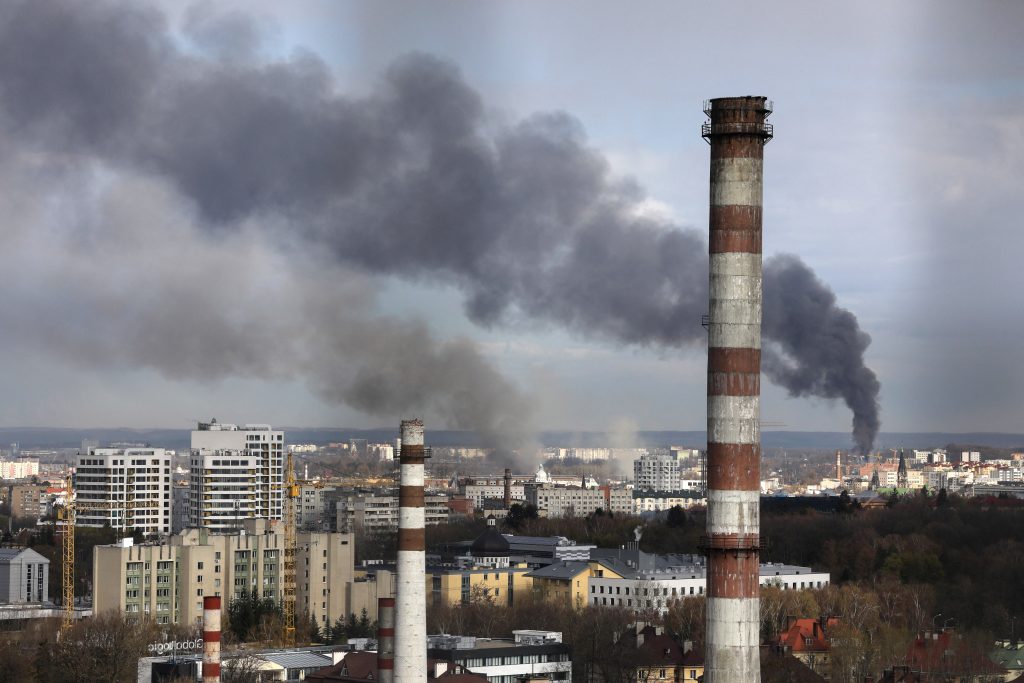
"Should the entrada in Ukraine continue through the leap and into the summertime without a decisive result, pressure on Putin and the Russian state volition intensify."
The Kyiv TV Tower is hit past Russia strike on March 1, 2022 equally Russia'southward invasion Smoke rises after war machine strikes, equally Russian federation's attack on Ukraine continues, in Lviv, Ukraine April eighteen, 2022. REUTERS/Roman Baluk
Targeting communications infrastructure. So far, Russia has non attempted to shut downward Ukrainian cellphone usage, partly to preserve telecommunication infrastructure for later on use, merely as well to listen in on Ukrainian communications and to use the network itself. Equally the prospect of victory recedes, Putin may reassess and make up one's mind to destroy jail cell towers and other facilities to restrict Ukrainian social media and internal communications. This will disrupt Russian intelligence gathering, but also degrade Ukrainian ceremonious and military communications and limit use of social media. However, given the large number of providers in Ukraine, complete loss of coverage or service is unlikely.
Heightening existential rhetoric. Equally internal opposition begins to organize and stiffen, Putin must strengthen his example for state of war and continued military action. He will do so by emphasizing manufactured threats to Russian territory, the Russian people (inside and outside Russia's borders), and Russian civilization. As they have to date, these themes will compete poorly with the reality shown daily around the world in media reporting and social media. Russian disinformation volition continue to dilate threats to the Russian homeland and the Russian diaspora to portray the entrada not as a war to "liberate" Ukraine, but as a defence force against an existential threat to the survival of the country itself. Putin might enlist the Russian Orthodox Church more than prominently than ever before in an attempt to portray the disharmonize in spiritual, as well as nationalist, terms. The reincorporation of Ukraine, in whole or in part, will now accept on the grapheme of a crusade.
To date, Russian cyber capabilities have been employed largely in direct support of Russia's military effort, for example, confronting Ukraine's military, intelligence, and police communications systems. At present, Putin will probably unleash comprehensive, full-spectrum cyberattacks against Ukrainian government, military machine, financial, and commercial nodes, in addition to precipitous, but not full-scale, offensive cyber activity outside Ukraine.
Disrupting oil and gas shipments. At this level of escalation, Putin is probable to remind NATO and the European Matrimony of his economic clout by more painfully halting or disrupting oil and natural-gas shipments. This will drive energy prices even higher, contribute to ability outages or rationing, and inflame opposition parties. Other critical exports may also exist halted by government decree. The intent hither is to generate internal domestic force per unit area in European capitals to cease or reduce military and economic aid to Ukraine, and to create pressure level for a diplomatic settlement favorable to Russia. These moves will exist painful inside Russia and represent a calculated chance—loss of revenue and investor conviction volition shock the Russian economy even more harshly—but, at this signal, Putin will need game changers to reverse a disastrous and deteriorating situation.
To stave off defeat, Putin must achieve a diplomatic settlement that leaves him with more than he possessed at the showtime. In all likelihood, this means a pledge of Ukrainian neutrality and the total, not partial, occupation of Luhansk and Donetsk, their incorporation into the Russian Federation, and possession of Mariupol and a land bridge to Crimea. Well-meaning leaders in the W will be tempted to agree to these conditions to "stop the killing," but this outcome tin can merely advantage Russian assailment and pb to more of the aforementioned in future years.
The fourth rung
Consolidating gains. Six months into the campaign, Russia will face ane of two outcomes. The first is gradual progress through a combination of mounting Ukrainian losses—both military machine and noncombatant—that lead to the loss of major urban centers and major groupings of regular forces. Shortages of food, fuel, spare parts, and precision-guided munitions—too as attrition of major combat systems, such equally gainsay aircraft, principal battle tanks, loftier-distance air-defense weapons, and self-propelled artillery—could, in time, wear down Ukraine's defense if not quickly replaced past friendly states. Grinding attrition and catastrophic destruction of industry, agronomical areas, and infrastructure may then forcefulness the Ukrainian government to accept a diplomatic settlement that will let Putin to claim victory. Such a settlement could include Ukrainian acceptance of Russian sovereignty over Crimea, Luhansk, Donetsk, and mayhap Kharkiv and Mariupol, as well equally a pledge of permanent neutrality. Putin would besides insist on easing of international sanctions as a precondition for a ceasefire. Despite serious losses and tactical defeats, information technology is also early to count Russia out.
In this example, Putin is likely to consolidate his gains, rebuild and better his forces, stabilize his internal domestic politics and economy, and endeavor to reestablish working relationships with Europe—to a higher place all, with Germany. Even plush success in Ukraine volition non, however, satisfy Putin. The invasion of Ukraine should exist seen every bit another step in an historic process that includes military aggression in Chechnya, Georgia, Crimea, and the Donbas, as well as the deployment of Russian troops in frozen conflicts in Armenia and Moldova. Further aggression in areas formerly belonging to the Russian empire—higher up all, the Baltic States—is highly likely post-obit a menses of reorganization and recovery.
Avoiding a stalemate or defeat through extreme escalation. The second outcome is a prolonged stalemate or outright defeat. In this scenario, after staggering losses and a scorched-earth campaign throughout Ukraine, Russian forces remain stalled. Ukrainian regular forces have suffered high losses but remain largely intact with high morale, while territorial defence forces continue to fight finer. Ukrainian performance is actually improving with gainsay experience, besides every bit growing conviction and elan. Western material and financial back up remains potent.
Internally, domestic unrest in Russia will become a serious threat to Putin'south regime, as crushing economic hardships mountain and Russian losses and lack of armed forces success become more widely known. Russian oligarchs facing financial ruin—every bit well as authorities, intelligence, and military machine elites who fear Putin's wrath and country collapse—may act to remove Putin from power. Pressure to resolve the disharmonize and reassert control may become overwhelming.
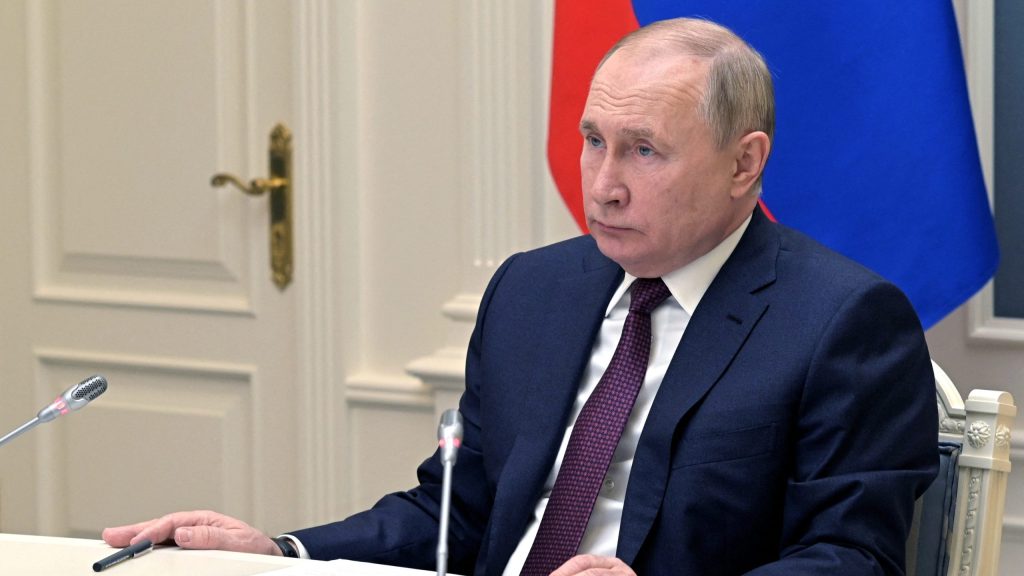
"In this scenario, Putin will have to consider more extreme and loftier-risk strategies to stave off defeat, prevent economic collapse, divert public opinion, and stay in power. Fifty-fifty more success in Ukraine, government survival will become the overriding priority."
Russian President Vladimir Putin observes exercise of the strategic deterrence strength in Moscow on February 19, 2022. Photo by Aleksey Nikolskyi/Sputnik/Kremlin via REUTERS
Transitioning the conflict in Ukraine into a frozen conflict lasting years, every bit has been done in the Donbas since 2014, may be Putin'south all-time selection now. A resolute Ukrainian government and highly motivated Ukrainian forces will proceed to fight to reassert sovereignty over the national territory. Continued Western support will enable Ukrainian forces to grow stronger, though information technology may not be possible to retake the areas newly controlled by Russia without more armor and combat aircraft. In this scenario, Putin volition have to consider more farthermost and high-adventure strategies to stave off defeat, prevent economic plummet, divert public opinion, and stay in ability. Even more than than success in Ukraine, regime survival will become the overriding priority.
With this in mind, what escalatory options could Putin choose?
Employing cyber tools. Under such drastic circumstances, Putin may elect to employ the full scope of his offensive cyber capabilities, which are formidable. Repeatedly in recent years, Russian cyber weapons have been employed successfully. While Russia has employed its cyber tools at the tactical level to some success in Ukraine, for reasons that remain somewhat unclear, the potential strategic effects of these weapons accept been held in reserve and so far in the campaign. Potential targets could include critical infrastructure such as power and transportation grids, nuclear-power plants, healthcare systems, authorities operations, the financial sector, and military command and control in the U.s. and Europe. These attacks would certainly invite retaliation, just Putin may see them as warranted to stave off defeat and preserve his regime.
Employing WMD. Putin may also cull to resort to weapons of mass devastation to cow the Ukrainian public and frighten off Western back up. This could take the form of chemical strikes using military-grade chemic agents, such equally nerve or mustard gas (although a signatory to the 1993 Chemical Weapons Convention, Russian federation is known to retain substantial stocks). Russian federation has already accused Ukraine and the United States of establishing chemical- and biological-weapons facilities inside Ukraine, a likely precursor to its ain use. Russian formations field organic nuclear, biological, and chemical (NBC) protection units at all levels, from brigade to combined-arms regular army, and Russian planners will surely contemplate using them if faced with a humiliating defeat.
Employing nuclear weapons. Use of tactical nuclear weapons inside Ukraine is also a possibility in a final bid to achieve military success, although senior Russian military officials may cramp at such an extraordinarily risky step. Every bit NATO's nuclear umbrella does non extend over Ukraine, Putin may discount the take chances of retaliation. An added benefit could be a precipitous warning of Russian federation's willingness to use nuclear weapons if provoked—for example, if NATO ultimately entered the conflict to save a foundering Ukraine. This choice would take the form of low-yield tactical weapons, launched from aircraft or field arms, or delivered via Iskander-M brusque-ranged ballistic missiles or Kalibr cruise missiles. Such use would non necessarily lead to uncontrolled escalation, and is well within the calculus of Russian military doctrine. The daze of such an event would exist profound, and could lead to Ukraine'southward submission or credence of unfavorable terms. Similarly, Russian forces could engineer a nuclear "accident" involving one or more of Ukraine's fifteen reactors, located at Yuzhnukraines, Rivne, Khmelnitsky, and Zaporizhzhia. (Chernobyl, located one hundred kilometers n of Kyiv, is not operational, but nonetheless houses large amounts of radioactive material.) The spread of radioactive fallout would, still, be very weather condition dependent, making this a very high-risk venture. Unquestionably, Russia would be condemned even by its few remaining supporters, to say nothing of an aroused and angry international customs. At this stage, Russia is already an international pariah, with little moral currency left to lose. Ordering the use of tactical nuclear weapons could well be game changing. It might also drive Putin from ability.
Destabilizing areas outside Ukraine. On the diplomatic and intelligence fronts, other possibilities also exist. The Russian authorities could further interfere in Transnistria or annex South Ossetia and Abkhazia, further complicating regional stability. Hostage taking—the arrest and detention of diplomats, journalists, concern executives, missionaries, and other strange nationals—would provide real leverage and aid to excerpt concessions. Targeted, non-attributed assassinations in strange countries are well inside Russian capabilities, and could sow confusion and help to destabilize opponents.
Russian information operations, then vaunted before the invasion of Ukraine, volition be of limited use now. Russian credibility abroad is so depression, and the evidence of Russian atrocities so overwhelming, that imitation-flag operations, fake news, doctored videos, and tortured narratives volition non gain traction exterior Russia and, over time, might exist more and more discounted inside. Similarly, few economical, fiscal, or commercial options will be in one case exports of critical commodities have been close off. An unintended outcome will be the evolution of alternate sources of supply for European and global customers, much as Keen U.k. and France plant other suppliers for cotton fiber during the Ceremonious War once southern shipments were embargoed. Loss of international credit, the plummet of the ruble, exhaustion of financial reserves, and lack of access to upper-case letter held exterior Russia will see Russia approaching economical collapse.
In short, while these more than extreme escalatory options deserve consideration, well-nigh would exit Russia in fifty-fifty worse shape and at greater risk. Russian elites almost certainly meet this. The more moderate and sensible approach—to withdraw to pre-war boundaries, offering concessions to Ukraine and the West, and open Russia to economic integration and improved relations with the international community—is highly improbable as long as Putin remains in power. The most likely consequence is that Putin volition continue to escalate until he is defeated outright, removed from power, or offered concessions he tin can take as victory.
The chance of horizontal escalation
Though it presents incredibly high risk, escalating the conflict across Ukraine's borders in the near term is an option Putin could consider if his survival is at stake. A straight set on on NATO territory—perhaps through Lithuania to obtain a state corridor to the Kaliningrad exclave and cutting off the Baltic States, should Russian forces find more success in Ukraine—is possible. The powerful Kaliningrad garrison, which includes nuclear-tipped Iskander-M and Kalibr systems, could assist. At bounding main, a desperate Russia might assail and seize commercial shipping in international waters on the Black Ocean and in the Baltic. Broadening the conflict to engage exterior powers more directly might finish the flow of support and lethal aid to Ukraine, throw NATO into disarray, create openings for sanctions relief, and rally an increasingly disaffected Russian population. If tactical nuclear weapons are postured for use, or employed in agony, the risks of uncontrolled escalation volition become quite real. Such use is not probable, but cannot be ruled out.
Other armed forces options likewise exist. Belarus has a substantial ground force of 4 heavy brigades, an airborne brigade, and stiff artillery, which remain uncommitted. Putin could, in outcome, have over and deploy this forcefulness in Ukraine or the Baltics, though its morale appears low. To distract and punish NATO for its support, hybrid operations in the Baltic States using Russian mercenaries, special-operations troops and intelligence paramilitaries from the Federal Security Service (FSB) and the Master Intelligence Directorate (GRU) could seize ethnically Russian parts of NATO territory (for example, in the Narva area in Estonia) and declare independence. While substantial Russian regular forces are not available in strength, this movement would provoke frantic diplomatic activity in NATO and the EU, and could provide leverage for negotiations and sanctions relief.
Horizontal escalation in other regions—such every bit the Arctic, the Mediterranean, and the Far E—is as well possible, simply would suffer from the same disability: lack of military resources to achieve any decisive result. To date, Russian naval forces are intact and could exist employed, only the Russian navy is not a true blue-water maritime force and, apart from nuisance attacks, could not realistically alter strategic outcomes. The same is true of Russian military aviation and space forces. Apart from generating confusion and a degree of misdirection, it is unlikely that these operations could contribute significantly to the success of the campaign in Ukraine, Putin's main goal. On the opposite, such operations could bring other military powers into the disharmonize against Russia, alienate others such as China and Republic of india, and change the correlation of forces decisively confronting Russia.
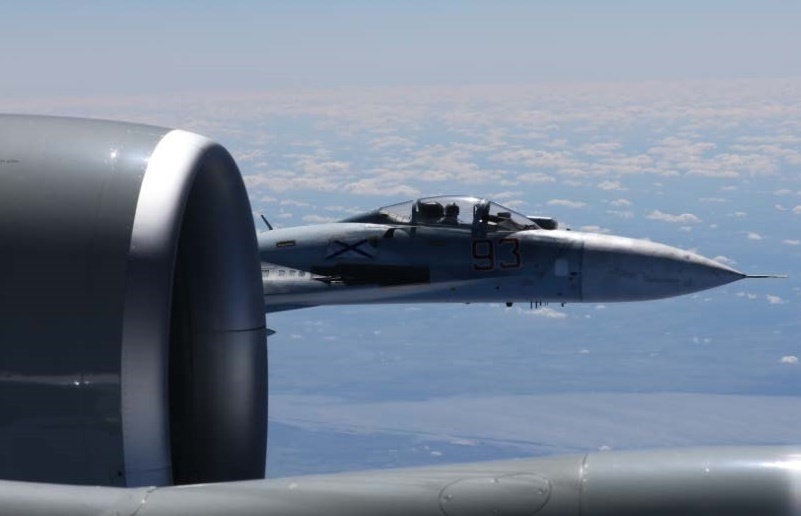
"If Putin achieves a measure of success in Ukraine, however, horizontal escalation in the next iii–five years is more likely."
A Usa RC-135U flying in international airspace over the Baltic Bounding main was intercepted by a Russian SU-27 Flanker June xix, 2017. Due to the loftier charge per unit of closure speed and poor command of the shipping during the intercept, this interaction was adamant to exist dangerous. (Courtesy photograph/Released)
If Putin achieves a mensurate of success in Ukraine, yet, horizontal escalation in the adjacent three–5 years is more than likely. Should the West decide not to provide offensive weapons or intervene directly, Putin can attain a negotiated settlement, leaving Russia in possession of the Donbas, Crimea, and perhaps Mariupol, along with a pledge of Ukrainian neutrality. In this instance, Putin would gain fourth dimension to shore up his authorities, rebuild his forces and economy, attempt yet again to develop a pro-Moscow regime in Kyiv, and pursue sanctions relief. Russian leaders volition be mindful that, despite the destruction inflicted on Ukraine and concessions forced on it, Western leaders were non willing to confront Russian federation directly. The Due west volition be seen as chance balky and field of study to farther rounds of intimidation. Hybrid approaches, with heavy emphasis on propaganda, subversion, disinformation and cyber operations, will figure prominently hither.
Preventing and controlling escalation
What can NATO and the European Union do to preclude Russian federation from escalating the conflict to unacceptable levels? What follows are a few principles to guide NATO's assessment of preventing and avoiding escalation.
Keep Ukraine in the fight. The starting time, and most firsthand, curative is to keep Ukraine in the war. This means continued fiscal help, shipments of lethal help, and existent-time intelligence sharing, as well every bit humanitarian help and help with assimilation and resettlement of refugees. The Usa and Europe have shown unity and concerted action in responding swiftly to Russian aggression in Ukraine and this must proceed, even as Putin seeks to find and drive wedges betwixt transatlantic allies and partners. In this struggle, a coherent narrative, shared and articulated in mutual, will be critical.
In this regard, continuous references to the danger of escalation to "Globe War III" and a steady drumbeat of measures not to be taken tin only serve to reassure Putin that he has a free paw in Ukraine. A caste of strategic ambivalence and the possibility of United states and NATO intervention should he become too far tin can be helpful in moderating Russian excesses and decision-making escalation. An "all measures on the table" approach will force Russian planners to consider, and prepare for, multiple response scenarios, complicating resources allocation and inducing uncertainty. While deterrence is more art than science, signaling to one'southward opponent that one is too frightened to engage is more than probable to encourage than to deter.
The most effective way to prevent spillover onto NATO territory and other forms of future Russian assailment is to help defeat Russian forces in the field inside Ukraine. Supplying Ukraine with nutrient, fuel, spare parts, and mod equipment is the best style to do that, while yet avoiding directly intervention by NATO. This means combat aircraft, master boxing tanks, infantry fighting vehicles, self-propelled and rocket arms, mobile air defense, secure radios, unmanned aeriform vehicles, target-acquisition radars, spare parts, and ammunition, including precision-guided munitions. Many of these combat systems be in storage in great numbers in the United states and in Europe. The Ukrainian military has shown remarkable versatility in adapting to unfamiliar systems such as the Javelin and Stinger, but exportable training packages, and even training sites in Europe for selected specialists, also warrant consideration.
If NATO intervenes, do it decisively. Several European nations, including Poland, Denmark, and Belgium, are considering some course of "peacekeeping" intervention in Ukraine, while calls for a no-fly zone are mounting as the civilian death toll rises. This suggests a critical mass of support may exist forming for outside intervention under certain circumstances. Strong material and financial aid may enable Ukraine to agree on, and even advance to retake occupied territory, simply Russian federation remains a far larger and stronger opponent. If the logic that it is ameliorate to defeat Putin in Ukraine than on NATO territory is sound, intervention to prevent the autumn of Ukraine or its dismemberment must exist considered. The prospect of actual genocide of Ukrainian civilians, or use of weapons of mass destruction, might also trigger NATO intervention.
This tin can take several forms. A no-fly zone would mean that NATO, or a coalition of the willing, employs combat aircraft based outside Ukraine to ground Russian military aviation, leaving ground combat to the Ukrainians (an illustration is the Kosovo air campaign). Unified command and control would be essential. The attempt would neglect if all targets required approving by thirty nations, so assuasive discretion to armed services commanders acting inside political guidance would be required. All Russian shipping entering Ukrainian airspace would exist engaged. Russian air defenses must be suppressed (perhaps fifty-fifty within Russia), frontward air controllers must be embedded with ground units to prevent fratricide, and target lists may be expanded rapidly to include attack of Russian missile and rocket systems that are destroying Ukrainian cities.
A no-fly zone is, of grade, an escalation itself, but ane intended to pb to a Russian defeat in Ukraine to forestall follow-on aggression in Europe. Entering the disharmonize from the air is a serious and sober pace. Some aircrew would be lost. Putin could retaliate by launching ballistic missiles confronting Smoothen, Romanaian, or other European targets. To do so, however, would mean expanding the disharmonize confronting a much stronger and wealthier NATO, at a signal at which almost all of Russia's available combat power is deployed in Ukraine. Intervention from the air also provides a clear firebreak. Introduction of big NATO ground forces would exist an even more than dramatic step Russia would surely seek to avoid if possible.
Introduction of "peacekeeping forces" or establishing a "humanitarian no-conflict zone" in western Ukraine, use of NATO special forces and trainers, and deployment of "niche" specialists with critical skills such as communications, targeting, and reckoner-network defense are also forms of intervention that could contribute to success in Ukraine. Unlike air operations, even so, these could make simply marginal contributions that may not exist worth the added risk of bringing the Brotherhood into the war. Should the entrada mature, and a no-fly zone materialize, these additional measures could augment Ukraine's defence in helpful means, but they should not precede air intervention. Straight intervention is a major step. It should not exist undertaken except to achieve a decisive issue.
Bolster frontwards presence. As a hedge against farther Russian aggression and to reassure allies, the US deployed 2 additional heavy brigades to Poland in February and early March, along with an airborne brigade, bringing the The states rotational "heel-to-toe" brigade there to divisional force. United states of america divisional and corps-level headquarters were too sent. The US 2nd Cavalry Regiment based in Germany (really a Stryker brigade) was relocated to Romania at the same fourth dimension. Additional air units and footing troops from a number of allies accept also been deployed to NATO's eastern flank, while the forty-thousand-soldier NATO Response Force (NRF) has been alerted for the showtime time in its history.
Putin'southward rhetoric and aggressive disinformation and subversion efforts have, for years, targeted the Baltic States, which stand between Kaliningrad and contiguous Russia and extend almost to the suburbs of St. Petersburg. To forestall time to come assailment and cement firm deterrence, these forces should remain in eastern Europe at least for the near term (i.e., 3–5 years). Equally the campaign in Ukraine unfolds, Putin should sympathize clearly that NATO is postured to respond strongly to further escalation.
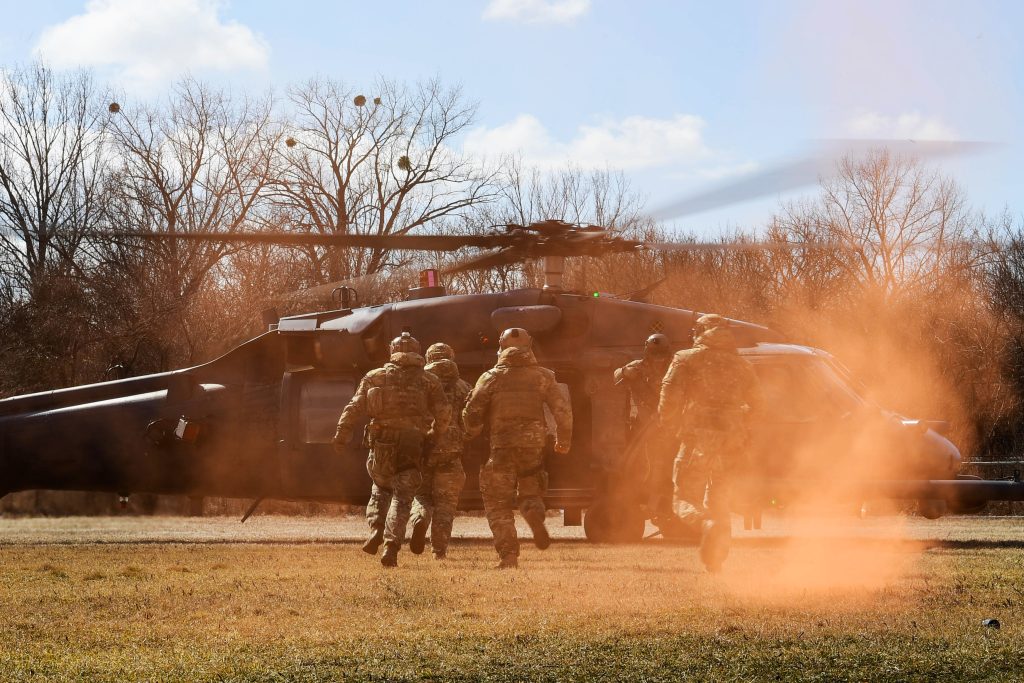
"Putin's threats were intended to keep his neighbors weak, but recent events have proven that it is the perception of weakness, not strength, that provokes him nearly."
The 51st Commando Battalion Romanian Special Forces run to an HH-60G Pave Militarist, assigned to the 56th Rescue Squadron, in Romania March, 9, 2022. (U.S. Air Force Photo past Senior Airman Noah Sudolcan)
For many years, policymakers accept argued strenuously against providing the Baltic States, and NATO's eastern flank in general, with an adequate defence for fear of "provoking" Russian federation and to "maintain Alliance unity." Measures to build up Ukraine's defensive capacity were resisted for the same reasons; the Barack Obama assistants opposed lethal aid, even afterward the invasions of Crimea and the Donbas, while the Donald Trump administration provided merely a trickle. The invasion of Ukraine has demonstrated the pitfalls of this thinking. Putin's threats were intended to go along his neighbors weak, but recent events have proven that it is the perception of weakness, not forcefulness, that provokes him most. Accordingly, a firm defense from the borders of Finnmark to the Black Sea can prevent spillover or regional escalation, communicate resolve, and reassure host-nation publics that the conflict in Ukraine will not land on their doorstep. This is nether style with the recent declaration that NATO battlegroups will exist posted in Romania, Bulgaria, Hungary, and Slovakia. Meanwhile, Federal republic of germany, the United Kingdom (UK), Denmark, and others have also pledged to increase their forces in the Baltic States.
To further strengthen deterrence and head off escalation, NATO should thoughtfully consider how best to help the Baltic States help themselves. Though proud members of the 2-percent club, their pocket-size economies foreclose them from acquiring the air defense and heavy forces they need to deter time to come Russian assailment. Estonia and Latvia field just a single light brigade each, while Lithuania fields a mechanized brigade with no tanks and a motorized brigade. Using security-help funds (such as the European Deterrence Initiative), the United States and NATO could equip existing Baltic formations with modern tanks, cocky-propelled artillery, and air defense from reserve stocks, along with the preparation, spare parts, and ammunition needed to make them viable. The Brotherhood should also strengthen the enhanced Forrad Presence (eFP) formations in the Baltic States, as Secretary General Jens Stoltenberg has suggested. These forces are too small-scale to pose a credible offensive threat, but can defend long enough for other NATO forces, such equally the NRF and US armored units in Poland, to motion upward to assist.
In the maritime domain, NATO's naval forcefulness conspicuously outmatches Russia's, merely operations in confined waters like the Baltic or Black Seas are complicated by country-based air and missile threats, as well as sea mines. Russian anti-ship missiles also outrange NATO's. Should Russian naval forces begin to attack commercial shipping in international waters, NATO can reply with standoff weapons, simply should exercise caution within range of land-based systems until they are suppressed. If Turkey agrees, stronger NATO naval forces should enter the Blackness Body of water to provide flexible response options to counter Russian maritime aggression.
Take an unambiguous opinion on nuclear policy. To relieve the threat of a Russian showtime-apply nuclear strike and regain freedom of action, the United States and NATO must return to core deterrence principles. As it has for many decades, nuclear deterrence rests on both capability and credibility. NATO nuclear forces, though much reduced since the Cold State of war (especially with respect to theater nuclear systems) are redundant, survivable, and absolutely capable of destroying Russia from finish to end. NATO's brownie, on the other hand, is constantly undermined when leaders publicly express palpable fears that Putin will employ his nuclear armory, for unclear reasons and in unclear ways, and that they must at all costs avert pushing him into a corner. A resolve not to be bullied is essential. Deterrence works all-time when leaders are straight, unambiguous, resolute, and calm, as John Kennedy was during the Cuban Missile Crisis. As President Emmanuel Macron reminded his public recently, the West has nuclear weapons, as well.
Use economic tools as a primary "offensive" weapon. As the military entrada progresses, sanctions will continue to strangle the Russian economy. This pressure must continue—and, if possible, intensify—in order to force Russia, not but to the negotiating table, but to withdraw altogether from Ukrainian territory. To date, non all Russian banks have been banned from SWIFT, and many oligarchs remain unsanctioned. Though painful and difficult, weaning Europe from Russian free energy, divesting from Russian businesses, and closing European markets are powerful weapons the EU tin can wield in its own right. (While 37 percent of Russian trade is with Europe, but 4 percent of the European union's goods exports go to Russia.) Today, Russian energy remains exempt from Eu sanctions. Developing alternating sources of free energy, in particular, volition take time and investment, but continued reliance on Russian oil and natural gas can only enable Putin to continue to finance the war in Ukraine.
In March 2022, the European union imposed its fourth tranche of trade sanctions on Russia, tightening consign restrictions on dual-utilise technologies, expanding the list of sanctioned persons related to defence force industries; imposing farther trade restrictions for steel, iron, and luxury goods; and prohibiting transactions with specific country-owned enterprises. The challenge now will exist to maintain the total range of sanctions until they bear fruit. Global nutrient shortages, rising energy prices, and scarcities among certain bolt will challenge the sanctions regime. Much depends on the persistence and resolve of Western leaders.
Properly understood, comprehensive economic sanctions against Russia—what the French finance minister has called "total economic and financial war on Russia"—can be a major tool, denying Putin the fiscal resources to carry on the war and generating internal pressures on elites that could lead to his removal. By themselves, even so, they will probably not end the war. China, Brazil, and India remain open markets and suppliers, if not agile supporters, while Hungary and Serbia retain close ties. As former Deputy National Security Adviser General Rick Waddell has pointed out to the author, "An economy that is self-sufficient in energy and nutrient takes a lot of killing." In concert with affairs, ambitious information operations, and the war machine instrument of ability, sanctions can exist a vital component of an overall strategy to control and limit escalation and drive conflict termination by draining Russia of the financial resources it needs to carry on the war.
Fix for the most probable area of escalation: cyberspace. Equally events progressively turn confronting Putin, the prospect of cyber war will loom always larger, as it represents ane of Russia's most powerful remaining weapons. Few Western nations possess true offensive cyber capabilities, and the United states alone possesses the ability to deter major cyberattacks by delivering constructive and large-scale reprisals. President Joe Biden has issued articulate warnings to the private sector to harden its cyber defenses, which remain patchy and incomplete, and put Putin on notice that cyber assaults on disquisitional infrastructure, the financial sector, and other key targets will be met with astringent retaliation. A complicating factor is that cyber warfare on a strategic scale has never occurred, and much remains unknown about it. For case, attacks on critical Russian infrastructure, such as power grids and transportation networks, could unintentionally cause civilian deaths, while intrusion into war machine command-and-command nodes could alarm the commanders of Russian federation's nuclear forces. In many respects, the cyber domain remains the realm of the unknown. Like aerial warfare in the early twentieth century, both sides must grope frontward and acquire as they become. A strong and clearly articulated cyber-deterrence regime, punctuated past sharp demonstrations if necessary, is the all-time defense here.
Maintain unity on the diplomatic forepart. In the midst of aggressive warfare, diplomacy may non capture the headlines. But, it must remain in play, in a higher place all because political objectives in the end must govern what happens on the battlefield. Here there are minefields. NATO and the EU may be tempted to intervene in negotiations and offer solutions—"off ramps" is au courant—to more than speedily achieve a cessation of hostilities. These could take the form of sanctions relief and acknowledgement of Russian sovereignty over parts of Ukraine in exchange for "peace." This would be a fatal error.
Practitioners of realpolitik may minimize Zelenskyy'due south emphasis on shared values and the ongoing contest between democracy and autocracy, but his denizens and millions in Europe and the United States won't. Despite the leverage the W has over Ukraine as its storehouse and quartermaster, the Ukrainian people will decide "how this ends." The political endgame—the definition of "victory"—must reflect outcomes they deem worthy of the enormous sacrifices they have made. The trap hither is that Putin volition not give up his aspirations if allowed to go along some of his gains, restore his finances, rebuild his forces, and try again.
The West has an opportunity to rule out that future altogether. That upshot rests on continued force per unit area, assistance to Ukraine, a resolute and united front, and the willingness to confront Russian federation decisively should Putin expand the disharmonize. Western diplomacy must be based on more than "stopping the fighting." The United States and its allies must run into through and beyond the endgame to a stable and lasting peace. That ways the comprehensive defeat of the Russian military machine in Ukraine, before the conflict metastasizes further and spreads into Europe and beyond.
Throughout, affairs should leverage the strong, worldwide opposition to Russian aggression—every bit expressed in the UN General Associates's overwhelming vote of March 2—in all international forums. Traditional neutrals such equally Sweden, Finland, and Austria have joined in strongly condemning Putin'south actions and have a growing vocalism. Edifice and sustaining this coalition should remain a meridian diplomatic priority.
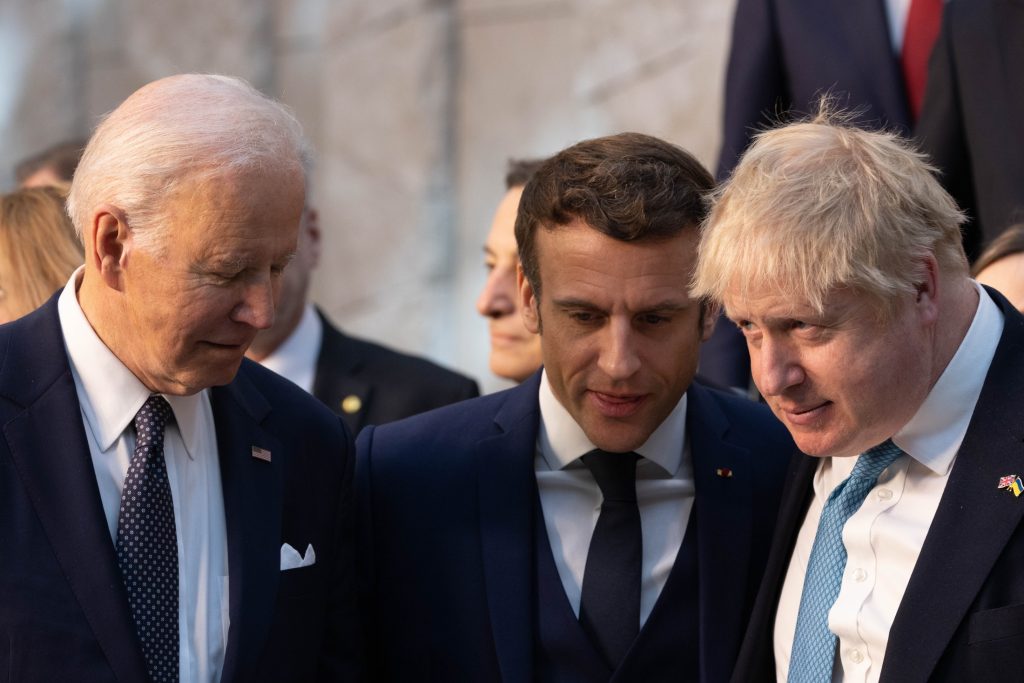
"Western diplomacy must be based on more than than "stopping the fighting." The United States and its allies must meet through and beyond the endgame to a stable and lasting peace."
Left to right: United states of america President Joe Biden with President Emmanuel Macron (France) and Boris Johnson (U.k. Prime Minister)
Summary recommendations
The issue of Russia'southward invasion of Ukraine is nevertheless uncertain. Much depends on a resolute response from the W. All courses of activity carry take a chance, but the greatest risk is a settlement that leaves Putin with substantial gains and poised to commit further assailment afterwards a period of retrenchment and recovery. To forbid this effect and as laid out in more detail above, NATO and European union members should
- agree on the defeat of Russian federation in Ukraine every bit the desired end state, vice a negotiated settlement that dismembers the Ukrainian state and allows Putin to claim success;
- step up lethal help to Ukraine, including the ways to deport offensive operations to recover occupied territory;
- consider direct intervention if necessary to preclude massive civilian casualties or utilise of WMD;
- maintain the presence of recent reinforcements on NATO's eastern flank for the near term (3–5 years);
- help the Baltic States to strengthen their defence establishments with armor, air defense, and self-propelled artillery;
- conduct recurring exercises from Finnmark to the Black Sea to enhance interoperability and forward presence;
- strengthen tactical nuclear systems in Europe to enhance deterrence;
- coordinate with Turkey for a stronger naval presence in the Blackness Body of water;
- sustain comprehensive economic sanctions until the desired terminate land is achieved;
- implement a coordinated information campaign with a consequent and focused narrative;
- harden computer-network defenses;
- be prepared to deport offensive cyber operations if required;
- provide economic assistance and humanitarian relief;
- reduce and eliminate dependence on Russian energy and rebuild energy security; and
- carry a sustained diplomatic endeavour, leveraging international organizations, to generate and maintain global pressure against Russian federation.
Conclusion
The Russian invasion of Ukraine is the almost dangerous issue to occur in Europe since the terminate of the Second Globe War. In its potential for enormous casualties, destruction on an epic scale, and escalation to unthinkable extremes, it demands the attention and considered action of NATO, the Eu, and the whole world. No one can see clearly exactly how the crisis volition play out. This "foreign voyage," in Winston Churchill's words, is a journey into the unknown, as all wars are. The best the Due west can practice is set up for the worst, keep its nerve, and utilise all its resources when its vital interests and most cherished values are attacked. Things are very close to that stage now. At stake is an international order founded on something other than creature force, imperial ambition, and autocratic self-assistance. A Russian victory in Ukraine, even at great cost, places a vengeful Putin on Europe's doorstep, his ambitions partially accomplished but even so unrealized. The side by side blow volition autumn on NATO'south eastern flank. Now is the time to ensure that never happens.
Author
Related content
Image: A service fellow member of pro-Russian troops in a uniform without insignia drives an armoured vehicle in the separatist-controlled village of Bugas during Ukraine-Russian federation conflict in the Donetsk region, Ukraine March 6, 2022. REUTERS/Alexander Ermochenko TPX IMAGES OF THE DAY
Source: https://www.atlanticcouncil.org/in-depth-research-reports/report/managing-escalation-in-ukraine/
0 Response to "What Conflicts Continues as Russia to Dominate Again"
Post a Comment