2019 Shopper's Guide to Long Term Care Insurance
Consumer Advocacy
What you need to know
Long Term Care Insurance
- Long-term care services are beneficial for seniors and individuals with physical or cognitive disabilities.
- Purchasing a long-term care insurance policy ahead of time can help you save on the cost of premiums.
- 70% of individuals aged 65+ can expect to use some form of long-term care.
- Regular health insurance, disability insurance, and Medicare are not designed to cover long-term care costs.
Our Approach
How we analyzed the best Long Term Care Insurance
Benefit Limits
We compared each company's daily benefit limit, which is the amount reimbursed daily for care services. We also reviewed their lifetime benefit maximum, which is the total amount of money that policyholders will be paid. Some LTC insurance policies have a limit on how much coverage is provided each day and, in comparison to the average costs of long-term care, the daily coverage may not be enough.
Policies & Coverage
LTC insurance coverage depends on your individual situation. Policy types, type of care and facilities covered, diversity of policy riders, and eligibility are all important factors to consider. We also consider the number of states in which the companies are licensed.
Customer Service
We deem customer experience important, taking into account customer care, claims processing, and website navigation. We also look into the company's reputation by examining consumer reviews and their financial strength ratings.
182 People found this helpful.
We receive compensation from thesepartners, which impacts the order they appear on the page. That said, the analyses and opinions on our site are our own and we believe in editorial integrity.
The following companies are our partners in Long Term Care Insurance: GoldenCare, CLTC Insurance Services, and LTCResourceCenters.com.
Our Top Picks: Long Term Care Insurance Reviews
A long-term care insurance policy (LTC) can help you pay for nursing home care, home health care, or assisted living in the event you are unable to take care of yourself due to illness or disability. Most health and disability insurance won't cover long-term care, and those that do, such as Medicare, only cover it for a temporary period.
Every year, however, more and more companies are stepping away from providing this type of insurance, and those that do tend to offer expensive policies.
Since premium prices are the reason many individuals overlook long-term care insurance, we focused our research on finding the providers that offer the most flexible benefit limits and money-saving features.
GoldenCare review
Also known as National Independent Brokers, Inc., GoldenCare is an online insurance marketplace that specializes in long-term care insurance, critical care insurance, and life insurance. This privately-held brokerage firm connects consumers with policies and services from top-rated carriers offering coverages that are tailored to their needs.
With several leading carriers in its network, GoldenCare provides diverse policy options, in addition to general long-term care policies. Consumers can choose from stand-alone nursing home care plans, short-term nursing home stays, annuities, prescription drug plans, Medicare plans and supplements, and home health care plans. This wide range of options caters to retirees, low-income households, couples, and more.
Online Resources
The company's homepage features a "cost of care" map, an interactive map that displays the average prices of home, assisted living, and nursing home care in different states, which is very useful. Users can also take advantage of the free online quote tool, as well as the wide variety of educational articles and FAQs. We also found it helpful that GoldenCare lists the carriers in its network on the About page. The list includes Mutual of Omaha, Genworth, Allianz, John Hancock, Aetna, and Humana.

Screenshot of GoldenCare.com's insurance carriers. August 9, 2019.
Spousal Waiver Premium & Survivorship Benefit
After calling and speaking with a representative, we learned about two additional riders available through GoldenCare. The Spousal Waiver Premium pays all premiums due if an insured becomes disabled, and the Survivorship Benefit, which waives monthly premiums for surviving widows on the policy. These add-ons are particularly beneficial for couples with one spouse in critical care or receiving long-term care.
Drawbacks
Although GoldenCare has received consumer comments on Google and Facebook, there isn't much about it on Trust Pilot or the BBB site. Bear in mind that consumer experience is an important factor to consider when purchasing long-term care insurance or any other type of service.
LTCResourceCenters.com review
Best For Chronic Care
LTC Solutions, also known as LTCResourceCenters.com, is an online marketplace for long-term care insurance with a focus on chronic health care solutions. As an independent managing general agency, LTC Solutions aims to educate and inform consumers about long-term care coverages tailored to their needs.
LTCResourceCenters.com works with a selection of insurance carriers that cater to chronic health care services. Individuals who suffer from chronic diseases are prioritized, with a product portfolio that includes Medicare supplement plans, critical illness coverage, and annuities, in addition to long-term care and short-term care insurance.
Sample Policies and Long-term Care Planning Guide
Users can find sample policies on the company's website to get an idea of how rates vary by age and gender. The website also includes very helpful and informative "how-to" and "did you know" articles on long-term care insurance and care alternatives. Lastly, consumers can download the company's long-term care planning guide and request a customized quote with side-by-side rate comparison from different companies.

Screenshot of LTCResourceCenters.com's of sample policy pricing. August 9, 2019.
Transparency
LTCResourceCenters.com is a very minimalistic website. As a marketplace, the company doesn't include additional content or confusing jargon but rather states exactly what it does and how consumers can use its services.
Drawbacks
This company doesn't have much of an online presence or customer reviews, which is common among brokerages. This could, however, give consumers who browse ratings and review websites the impression that the company is inoperative. Also, we noticed that LTCResourcesCenter.com doesn't list the insurers in its network. We think it would benefit consumers if the company listed the carriers they might end up doing business with.
CLTC Insurance Services review
Best For Comprehensive FAQs
California Long Term Care Insurance Services, Inc., also known as CLTC Insurance Services, is an insurance aggregator that aims to match consumers with the best long-term care insurance policies for their needs.
CLTC's FAQs section is a great resource for understanding the intricacies of long-term care insurance, featuring in-depth questions and comprehensive answers. The company's website also includes a resource page with an educational blog and, helpful external links, and can connect visitors to government associated sites. Our team called CLTC to inquire about policy options, and the representative was very helpful. Although we received general information, the rep was transparent about the average cost of policies, stating that the average policyholder's age is 57 and the average monthly cost is around $150 per month.
Quote Comparison
Consumers can use the free online quote form to receive long-term care insurance quotes from multiple carriers. This option makes CLTC Insurance Services a one-stop-shop for those seeking quotes and easy comparisons between plans. The company states that dedicated representatives will work with clients to provide them with multiple quotes, assess their needs, and educate them on the best plans and applicable discounts.
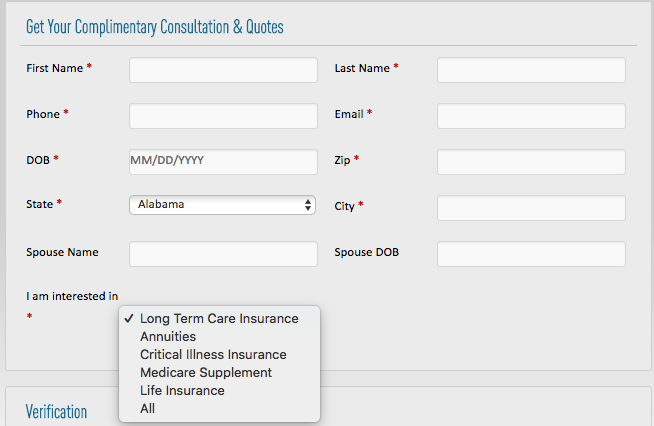
Screenshot of CaliforniaLongTermCare.com's Consultation & Quote request form. August 9, 2019.
Policy Customization
CLTC Insurance Services doesn't have any information on its website regarding policy options, so our team reached out to one of the company's customer service associates. The associate informed us that, in addition to general long-term care insurance options, CLTC Insurance Services offers critical illness insurance, as well as riders that add home modifications and mental illness coverage to the policy. He did not provide further details about these two riders but stated that policyholders have the choice between an elimination period of 30, 60, or 90 days.
Drawbacks
CLTC does not offer its services nationwide, so we encourage consumers to first call to inquire states served before requesting quotes. Also, the company does not list the insurers within their network. Lastly, the company lacks a digital presence and has a rather outdated website interface, which can send the wrong message and affect the company's credibility.
New York Life review
Best For Customer Resources
New York Life is a mutual life insurance company that serves policyholders nationwide and has no outside investors. In addition to life insurance, it also offers investment and business services and has an exclusive partnership with the AARP to provide affordable long-term care insurance policies.
In addition to a user-friendly interface and easy navigation, New York Life's care cost tool is useful for finding out the average cost of home care services, nursing homes, and assisted living facilities in every state. It also provides an agent and office locator, another plus in terms of navigation assistance.

Screenshot of NewYorkLife.com's Care Cost Tool. August 9, 2019.
We found the featured articles and insurance needs calculator to be useful additions that both educate and guide consumers on policy decisions. Lastly, the company provides nationwide service through captive agents that represent and sell for New York life only.
Budget-Friendly Customization
New York Life offers both traditional and hybrid long-term care insurance and customizable life insurance policies. The elimination period is generally set at 90 days but is at the discretion of the policyholder and what works for their budget.
After speaking with a helpful service representative about the benefit triggers—the six activities of daily living that policyholders must need help with to receive benefits—we learned that New York Life prioritizes diagnosis of cognitive impairment, such as dementia, as a determining factor for benefits to start.
Most underwriters only consider the inability to do two of the six activities of daily living (ADLs), not considering that cognitive impairment can prevent an individual from performing those activities, even though they're still physically capable of doing them. As opposed to comprehensive and hybrid policy types, New York Life also offers dedicated nursing and residential facility policies, which can be more affordable.
Transparency
We spoke with a helpful New York life customer service associate who gave us detailed information about long-term care options as well as general advice on insurance shopping.
The company also stands out by allowing customer reviews, ratings, and comments on its social media platforms, regardless of critical feedback e. Last, but not least, we commend the company for providing sample long-term care policies on its website, which we haven't seen with other popular insurance companies. Users can download PDF versions of both its comprehensive policy sample and nursing home only policy sample.
Drawbacks
Current and former policyholders give New York Life a 2.5 out of 5-star rating on its Facebook reviews. While this may be average for an older and financially stable company, many similar customer complaints on the Better Business Bureau align with this rating. This surfaces potential issues regarding the company's customer service approach. Other comments cite problems with death benefit payout delays of several months. New York Life, however, is very responsive and attentive on both its BBB and social media pages, resolving complaints and addressing the matter in a timely fashion.
Mutual of Omaha review
Best For Discounts
Mutual of Omaha is a privately-held mutual insurance company with over 100 years of experience in the industry. In addition to long-term care insurance, the company offers disability income, Medicare Supplement coverage, and a wide range of customizable insurance, financial, and banking options.
It's common for long-term care insurers to offer discounts for spouses. With Mutual of Omaha, however, policyholders with insured spouses can receive up to 30% savings, which is in the higher end, and even 15% savings if they have a spouse or partner who is not under the policy. Another complementary discount is 15% savings for good health, which comes in handy for those who were proactive and bought policies at an early age. It's definitely helpful for those who are still too healthy to receive benefits.
Policy Estimate Calculator & Other Customer Resources
Mutual of Omaha's website is very user-friendly. Visitors can easily find tools and resources, including an agency locator that automatically pinpoints your location and connects you with an agent in the area. In the long-term care insurance sections, users will find a policy estimate calculator, review the average cost of care, and access claim forms in English and Spanish. We also found their blog to be very organized, covering the "who," "how," and "why" across various insurance plans and financial services.

Screenshot of MutualofOmaha.com's Cost of Care calculator. August 9, 2019.
Superior Financial Strength
With an A+ rating from A.M. Best, Mutual of Omaha is recognized in having a "superior" financial strength, showing consumers that it's fully capable of paying out claims. The company also has an A1 rating from Moody's and an AA- rating from S&P, signifying it has a superior ability to meet its financial obligations to policyholders and is in the upper range of low credit risk.
Drawbacks
While navigating the company's website, we encountered a few broken links, including one in the blog resource section that bounced us to a "500 oops, sorry" recovery page. We also noticed a pattern of customer complaints regarding denied policies and issues with customer service during our research. Although negative reviews are common when dealing with large companies, especially in the insurance industry, they may deter consumers who regard popular review platforms from doing business with the company.
MassMutual review
Best For Short Elimination Period
Massachusetts Mutual Life Insurance Company, or "MassMutual," ranks as the sixth-largest life insurance carrier in the United States. As its name implies, MassMutual is a nationwide mutual company that offers a wide range of life insurance, long-term care insurance, retirement, and investment products.
With most long-term care insurance plans, the elimination period—the waiting period before a policyholder can receive benefits—is generally 90 days. Consumers should understand, however, that elimination periods can be measured in two ways, either by calendar days or days of service, which can be much longer. Fortunately, MassMutual policyholders can opt for the Enhanced Elimination Day rider add-on, where one day of care is equivalent to seven calendar days, thus shortening the waiting period.
Outstanding Financial Strength
MassMutual's financial strength is deemed "superior" by A.M. Best, which has given the company an A++ rating. The company also has an Aa3 rating from Moody's, signifying the company poses the lowest level of credit risk, and an AA+ from S&P, suggesting "very strong" capacity to meet its financial obligations. This outstanding financial strength indicates that MassMutual is dependable in paying claims and able to meet its financial obligations.
User-friendly Website & Resources
At Massmutual.com, visitors can quickly search for a financial advisor, access helpful blog posts and FAQs, file and submit claims, and download claims forms. The insurance calculator is particularly handy for helping you analyze your income and how much you can expect to save for college and retirement, or need for life and disability insurance.
Our team contacted more than one financial advisor and received immediate and helpful information. Both were informative, well-versed in insurance terminology and rider options, and didn't put on pressure to buy a policy.

Screenshot of MassMutual.com's claims submission tool. August 9, 2019.
Drawbacks
There isn't much information about long-term insurance on MassMutual's website. Consumers must contact an advisor to learn more. It's also worth mentioning that the company received a class action lawsuit alleging unpaid dividends and, under the proposed settlement, was ordered to pay $37.5 million in November 2017. Our team came about this information after reviewing a pattern of complaints on BBB.org that correspond to the same issue.

Our Research
More insight into our methodology
Researching and educating ourselves on long-term care insurance was honestly more challenging than we expected. It is an insurance industry in decline, meaning policies are becoming more expensive, which discourages consumers from buying. As a result, more insurance companies are ceasing sales of long-term care policies.
As a policy gradually leaving the insurance market, one would think there would be a plethora of insurance options to fill the gap—well, think again. Medical insurance does not cover long-term care (LTC). And while 70 percent of seniors ages 65 and older are expected to need some form of long-term care, the intimidating cost of LTC policies contributes to the reason fewer consumers look into it.
Instead, life insurance is a popular and highly sought-after policy, so insurance companies have turned to offer life insurance policies with LTC benefit add-ons. The dilemma occurs when policyholders realize that using LTC benefits sometimes depletes death benefits, meaning they can opt to receive payment for long-term care or funeral expenses, not both.
With that said, we really had to buckle down in our research strategy: finding companies that actually still sell standard long-term care insurance policies or hybrid policies with life insurance, not LTC benefit add-ons, which is why many large and popular insurance corporations didn't make our cut. For those that did, we analyzed the three factors below to make sure companies offer consumers the most affordable care.
Benefit Limits
Like many other types of insurance, long-term care insurance policies have benefit limits, which cap the amount of money the insurance provider will pay toward covered services. In long-term care insurance, there are either daily or monthly benefit limits, as well as a maximum benefit period, which you select upon enrollment.
It's important to consider the amount of coverage provided by your policy when crunching numbers. For example, if your daily cost of long-term care is $100, and you selected 80% coverage with a $100 daily limit, you will receive $80 in benefits from your insurer and be responsible for the remaining $20 out-of-pocket.
Policies & Coverage
Long-term care coverage isn't one-size-fits-all, so we review insurers that provide flexible policy options to meet your needs and adjust to your required level of care as it changes. Whether you live at home, in an assisted living facility, or in a nursing home, the most comprehensive policies provide full coverage for these diverse living options.
Since some states also offer partnership policies that allow policyholders to retain a specific amount of their assets, we examine companies that offer nationwide service, or at least a large percentage of it. Also, regarding eligibility, the general standard to qualify for long-term care benefits is the inability to perform at least two out of the six activities of daily living (eating, bathing, dressing, transferring, incontinence, and using the toilet) or have a diagnosis of cognitive impairment. We verified whether the companies were reasonable with these standards since policyholders commonly complain about their claims being denied.

Customer Service
Customer experience is valuable, which is why we encourage consumers to read reviews from customers who've done business with our list of companies to help them make a decision. With that in mind, know that reviews can also be biased. We advise that you not rely on too many emotionally based responses, but rather look for patterns of specific complaints among customers, to pay particular attention to how often the insurance company responds to claims and complaints, and analyze resolutions to said issues.
Also, financial stability is an important factor for businesses, especially insurance companies. Financial strength is a good indication that your insurance company is reliable and able to pay out claims. Grade "A" ratings and above from popular rating corporations, such as A.M. Best, Moody's, and Standard & Poor's, are key. We made exceptions for long-term insurance companies that are brokerages, understanding that there are diverse insurance companies within their network.
Helpful information about Long Term Care Insurance
Long-term care insurance is a breed of its own. Unlike other types of insurance, such as life insurance and medical insurance, in which you have a solid reason for purchasing them, long-term care is the type of insurance that makes you ask, "Do I really need this?" The average person is not trying to spend money on an insurance policy to cover something that may or may not happen twenty to thirty years down the line. Yet, those who do try to obtain coverage don't do so until it's too late.
"Home care on average can cost $132 a day. Adult day services can cost $72 a day. Assisted living facilities can cost $4,000 a month or $48,000 a year. Semi-private rooms for a nursing home can average $245 a day or over $89,000 a year. You can see these costs can add up very quickly.
We know that long-term [care] insurance can be a huge help for families, but most of the families we deal with do not have it. And we also know that the best time to plan for long-term care is to do it before you need it, but many families don't have these important discussions until they're in a crisis situation."
- Ruth Drew, Director of Information & Support Services at the Alzheimer's Association
The key is to understand exactly what long-term care insurance covers and why this type of insurance is beneficial for your quality of life.
Consider your grandmother who sometimes needs the help of her cane to get around or your favorite uncle who survived a heart attack and now must monitor his blood pressure and diet—both currently need an eye kept on them from time to time. Has anyone in the family discussed future caretaker plans in case their health worsens? Are you all aware of any diseases or illnesses that run in the family, such as dementia or diabetes?
This is when you should start thinking about long-term care: many, many years in advance. Long-term care insurance is designed to cover the costs of consistent care during an extended period of time. If your grandmother or your uncle's condition becomes debilitating, long-term care insurance policies could reimburse them a daily amount of money to cover care services.
Before choosing a long-term care insurance plan, it's important to analyze and weigh your options. We'll walk you through the statistics of long-term care to help you reach a better understanding of how to prepare, followed by an explanation on what to expect from long-term care insurance providers.
Long-term Care Statistics
It's easy to think your family will step in and care for you in your later years, and while about 80 percent of home care is provided by unpaid caregivers, such as family members and close friends, it doesn't mean they will have the experience or the time to do so.
According to the U.S. Department of Health and Human Services, the average caregiver spends 20 hours a week providing care. It takes commitment for someone to dedicate at least four hours of long-term care services each weekday, especially if they have a job or are caring for their own children or home. Graciela García, a retired registered nurse, spoke to us about her own experience providing in-home care for her mother before her passing. Garcia's mother, who suffered from the third stage of Alzheimer's, needed round-the-clock care.
García explained that although she was a nurse, the tasks she performed were still physically and mentally exhausting. She didn't have help from other family members to care for her mother and was also a widowed mother of two young children. García was grateful that her mother's medical insurance at the time provided for medicine and other necessary equipment, but she the type of care her mother needed required her undivided time and attention, forcing her to seek financial assistance to help pay their utility bills.
Cost of Care
Consider how much more expensive it would have been for García to provide care for her mother had she not be an experienced registered nurse or had full-time availability to do so.
Let's take a look at the average cost of different long-term care services:

**Stats based on Genworth Cost of Care Survey 2018, calculated as average annual cost assumed at 40 hours per week
Keep in mind that these costs are only the nationwide average. They will vary depending on the state, region, facility type, and specific services required.
Care Factors
Additional factors to become familiarized with are age, health, and gender. These are what insurance underwriters analyze when determining care eligibility and individual policy prices. Statistically, women outlive men by 5 years and therefore are more likely to require care. Also, single individuals are more likely to need a paid care provider. It's true that there's a chance you'll never need to use your policy, but that probability ratio is 50/50.
Types of Long-term Care
There are different styles and living arrangements for long-term care, depending on the patient's needs and comfort. Long-term care insurers generally offer coverage for the following:
In-Home Care
Some people desire to stay in their own home: it's comfortable, it's familiar, and it's private. Not everyone needs 24/7 support or assistance and, depending on the individual's needs, in-home services may be easier and much more affordable. The two common types of in-home care covered by long-term care insurance are personal care services and professional services. Personal care consists of handling daily care tasks, such as dressing and bathing, as well as homemaker services, such as cooking, household chores, and shopping. Professional care involves sending qualified individuals to perform medical assistance, such as a nurse, home health aide, or therapist.
Nursing Homes
Nursing homes can provide the care needed for individuals unable to live independently, as they require either round-the-clock care or assistance for most activities of daily living. Of all the care services covered, a nursing home is typically the most expensive, as residents require the most amount of care from professionally-trained staff and medical personnel.
Assisted Living Facilities
If you are able to live independently but need access to assistance or medical care, an assisted living facility may be a good option. In addition to the services provided with in-home care, assisted living may also include meals, recreational activities, transportation, and access to on-premise community facilities. Adult daycare and continuing care retirement communities are also covered under this option.
Hospice Care
This type of care is meant to provide comfort and support to patients in the final stages of a terminal illness, with a focus on quality of life rather than a cure. The ultimate goal of this care service is for individuals to live as comfortably and pain-free as possible.
Medical Devices
Some long-term policies also cover the cost of either rented or leased in-home medical devices, such as respirators and hospital/adjustable beds.
Industry Trends
Before shopping and comparing long-term care policies, it's best to have some background information on commonly-used terms and industry-standard policies.
Here's what consumers can expect from long-term care insurers:
Types of Policies
-
Traditional Policy - The standard long-term care insurance option that can be customized according to the policyholder's needs.
-
State Partnership Policy - A federal program, also called the "Long-Term Care Partnership Program," offered in several states. The goal is to increase the total value of assets participants could retain and still qualify for Medicaid, thus encouraging more people to purchase policies. All states except Alaska, Hawaii, Illinois, Massachusetts, Utah, and Vermont participate in the program.
-
Tax-Qualified Policy - Plans in which you can deduct long-term care insurance premiums as a medical expense tax write-off. Medical expenses are tax-deductible as long as they exceed 10% of your gross adjusted income.
-
Hybrid Life Insurance Policy - Newer forms of long-term care insurance combine whole life insurance policies with long-term care coverage or an "LTC rider." The advantage of these hybrid policies is that they'll pay out, no matter what happens to you.
-
Group & Employer Policy - Cost-effective policies offered as part of a group or through an employer's benefits plan. The insurance company has the advantage of charging less per policy in exchange for selling dozens of them at once.
Policy Riders (Add-Ons)
Policy riders are extra features that can be added to long-term care insurance plans at an additional cost. Though not every insurer will offer these, the most common long-term care riders include:
-
Inflation Riders - A very common rider that increases daily maximum benefits and your lifetime maximum benefits by a fixed percentage every year for a specified number of years.
-
Increased Benefits - Add this rider to increase the daily maximum benefit or the lifetime benefit limit on your existing policy.
-
Spouse Survivorship - When one spouse dies, the surviving spouse on the policy will no longer have to pay their monthly premiums, but will still receive coverage.
-
Shared Care - Allows you and your spouse to pool your long-term care insurance benefits rather than requiring each person to have their own separate policy.
-
Return of Premium - Upon the death of the policyholder, a portion and, in some cases, the total amount of premiums paid for the policy will be returned to the designated beneficiary. These types of add-ons can increase policy rates by almost 50%.
Discounts
As mentioned earlier, some long-term care insurance companies offer employee discounts for corporations, since they'll receive dozens of policyholders in return. Consumers can also expect partner or household discounts, in which the policyholders receive a special rate if they're married or cohabitating. Lastly, there are insurers who supply other types of insurance in addition to long-term care, such as life insurance and disability insurance, and may offer multi-policy discounts to those who purchase more than one.
Eligibility for Benefits
In order to qualify for benefits, you must be unable to perform at least two of the six activities of daily living. This includes bathing, dressing, moving to and from the bed, using the toilet, eating, and maintaining continence (bladder and bowel control). A medical professional is required to prove your lack of mobility and determine if it's expected to prolong at least 90 days.

Benefits & Considerations
Since long-term care can be very expensive, long-term care insurance can protect your savings and help you maintain a better quality of life as you age. Though it usually doesn't cover the full amount, it will reimburse a portion of the cost of care from a nursing home, assisted living facility, or in-home care. Also, there are some tax benefits associated with long-term care insurance, where some state and federal tax deductions allow you to write off premiums as medical expenses.
On the contrary, this type of insurance is meant to be purchased early on in life when you're still healthy, as cost and denial rates increase as you get older. According to the American Association for Long-Term Care Insurance, 22% of applicants ages 50-59 are denied coverage.
Long-term care insurance premiums can be pretty expensive, which can be a financial burden for many, as they'll be paying it for many years. Also, this type of insurance is not an investment. Unlike life insurance, which is guaranteed to be paid out, if you never need or meet the qualifications for long-term care, you may not receive the insurance benefits.
Alternatives for Covering Long-Term Care
After reviewing your options and understanding the pros and cons, you may decide that long-term care insurance is not for you. Although you can't count on Medicare to pay for nursing home, home health care or assisted living, there are other alternatives to paying for long-term care:
-
Save money for long-term care . Considering the average cost of care, it's definitely something that you want to start saving up for. Apply a portion of any benefits you've earned over the years, such as veteran's benefits, your retirement fund, trusts, etc. to cover long-term care expenses.
-
Open a Health Savings Account (HSA) , a savings account which allows users to earn tax-free interest and set aside savings for medical expenses.
-
Purchasing a life insurance policy with a long-term care rider is also an option, as it's generally cheaper than a standard LTC policy.
-
Life Plan Communities , or continuing care communities, are also an alternative as members are guaranteed access to care even if they aren't able to pay for it. However, in addition to a monthly payment, these communities are expensive, requiring a hefty upfront payment—usually thousands of dollars.
-
Apply for federal LTC coverage through the Federal Long Term Care Insurance Program (FLTCI). This program, sponsored by the U.S. Office of Personnel Management (OPM) is available to federal employees, active and retired members of the uniformed services, U.S. postal service employees, and qualified relatives.
Medicaid can help with certain kinds of in-home care for people who qualify. Some people also qualify for veteran's benefits, depending on when and where they served.
What to Watch Out for When Buying Long-Term Care Insurance
You may notice that most insurance companies intentionally don't go into much detail on their websites, but rather encourage visitors to find and contact their advisor. Take advantage of your conversations with these advisors, asking as many questions as possible and clearing up any confusion or concerns you may have about long-term care policies. Ask if they can send you a sample policy and walk you through terminology, jargon, and examples. When doing so, here are a few things to keep in mind:
Customization Options
Just as with other types of insurance, the shorter the deductible or wait time (elimination period) to receive benefits, the higher the cost of the plan. Beware of tricky wording regarding customizable elimination periods. You don't want to get persuaded into adding many policy riders to your plan and other customization options only to end in paying a high premium over the course of 10 years or more. The truth is, many providers offer customized plans. Do what's best for your budget and specific needs.
Waiting Periods
During our research, we reached out to a few long-term care insurance providers to inquire about their plans and learned a lot more about them than meets the eye. To start, elimination periods, also known as "waiting periods," are not measured in actual calendar days, but in the days of care. Most long-term care plans are set with a general 90-day elimination period. The average consumer may look at that as a three-month time span, but in reality, it can be much longer, even years longer. The policyholder may not be hospitalized or receiving care for a consecutive 90-day period.
Long-Term Care Insurance vs. Long-Term Care Rider
The difference in plans was something we found quite confusing when we first tackled this subject. An insurance plan, such as life insurance, with a long-term care (LTC) rider, or "add-on," is not the same as a long-term care policy. They may offer the same benefits, but there are many differences, especially in price, coverage, and eligibility.
Opting for a cheaper insurance policy, such as life insurance, with an LTC rider may limit specific areas of coverage, such as the type of care or facility, as well as affect other benefits, such as depleting your death benefit. Be sure to discuss the differences and options with your customer service representative or advisor.
Premiums Increase with Age
The best time to start looking into and considering long-term care insurance is in your early senior years, while you're still in good health. According to the AARP, one should do so while between the ages of 50 and 60. Initial premiums at age 65 are 8%-10% higher than premiums of those who are a year younger. Keep in mind, it's already difficult to qualify for long-term care insurance benefits. Underwriters look for debilitating conditions, such as an injury, but not deadly, such as a stroke. The older you are, the more at risk you are of having a terminal condition.
We spoke with Bill Robinson, a Virginia-based nurse technician with years of experience working in a nursing home and the long-term care industry. After seeing residents struggle with basic activities that an average person may take for granted, such as getting dressed each day, Robinson told us he was convinced to purchase a long-term care insurance plan. He explained that working with senior patients and watching their experiences definitely influenced his decision to buy a policy while still in his 50s.
FAQs about Long Term Care Insurance
Is long-term care covered by Medicare or Medicaid?
Medicare generally does not cover long-term care services, except under rare circumstances. Medicaid, on the other hand, can be applied to long-term care services for those who qualify for the program, providing coverage for nursing homes and other types of long-term care, but by law has a limit up to 100 days of covered services. Medicare is designed to pay for the health care of citizens ages 65 years and older, covering necessary yet acute care, such as hospital stays, doctor visits, and prescription drugs. As for Medicaid, rules vary somewhat state by state, but it will generally pay for long-term care as long as the patient's income is under a certain level and his or her wealth does not exceed $2,000 in assets. Be advised that this figure can be higher in states that participate in the Long-Term Care Partnership Program, which allows people with qualified long-term care insurance policies to retain a larger portion of their assets and still qualify for Medicaid coverage.
Why should I consider long-term care insurance?
Long-term care insurance is designed to help cover the costs of institutional care, such as nursing homes and assisted-living care, should you need the service in the future.
Whether by injury, illness, or disability, many citizens are unable to perform normal activities of daily living, such as bathing and eating, on their own. According to an AARP study, about 60% of adults that need assistance in performing everyday activities are at least age 65 or older. While it's more common among senior citizens, they're not alone. About 13 million people of ages 18 and over need daily-living assistance.
Health and state of living have no guarantees, and assisted caregiving over extended time periods is very costly. Long-term care insurance can be a way to be proactive against the financial burdens of extended care. These types of policies reimburse the policyholder a specified amount for daily care during a predetermined period.
What is the difference between long-term care and disability insurance?
Long-term care insurance covers the cost of services and supports a person's needs for an extended period of time due to physical limitations or cognitive disability. Examples of long-term care include home health care, nursing homes, adult day-care, and assisted-living facilities. Disability insurance, on the other hand, is a protection policy against loss of income due to illness, injury, or other disabling conditions that keep an individual from working.
While both forms of insurance provide financial support to disabled or injured policyholders, they're not to be confused or applied to the same circumstances. Long-term care insurance policies only reimburse the policyholder a specified amount of money to cover the expenses of daily care services. Disability insurance, also known as disability income, is designed to pay a portion of the policyholder's income in the event they're unable to work for a certain period due to a sudden illness or a work-related injury. Disability insurance is for anyone who wants to protect their income; long-term care insurance is most likely only available to individuals who cannot work at all or don't plan to return to work.
When is the best time to get long term care coverage?
An ideal time to start looking into long-term care insurance is between the ages of 50 and 60 when people are less likely to need care.
The key is to buy coverage before you actually need it. As with most insurance policies, you'll likely have a lower premium and a lesser chance of being denied coverage due to existing health issues. If you're already receiving long-term care or have poor health, you may not qualify for insurance.
What is an Elimination Period?
An elimination period, also known as the waiting period, is the amount of time before a policy will begin paying benefits. The elimination period can be understood as a type of deductible, in which the policyholder must wait a certain length of time before the insurance company will begin to make payments. Generally, long-term care insurance policies have a 90-day elimination period. The shorter the period, the higher the premium and vice versa. Be sure to understand how the company calculates the elimination period of the policy you are considering.
How is the cost of long-term care insurance determined?
Long-term care insurance premiums are determined based on a number of factors, including one's age when purchasing the policy, the amount the policy reimburses per day of care, how long the policy will provide coverage, any additional coverage benefits selected, and more.
Long-term care insurance is not one-size-fits-all, meaning it is customized to best serve policyholders. As with other types of insurance, there is an underwriting process that determines the final cost of the long-term care policy. Also, if insurers take into consideration policyholders who desire coverage with their spouse, factors change. Typically, long-term care insurance providers offer discounts for couples, some up to 30% or more.
Latest From Our Editors
2019 Shopper's Guide to Long Term Care Insurance
Source: https://www.consumersadvocate.org/long-term-care-insurance
0 Response to "2019 Shopper's Guide to Long Term Care Insurance"
Post a Comment